
BUILDER INSIGHTS
How Much Should a Custom Home Builder Spend on Marketing?
The benchmark says 5 to 10 percent of revenue. The industry average is 0.8 percent. Here is what to actually budget, by revenue band and by channel.
ESTIMATED READ TIME: 8 MINUTES
Want to skip the reading? Speak directly with our Director of Growth Strategy.
A custom home builder in growth mode should plan on roughly 5 percent to 10 percent of gross revenue for marketing. A builder with a full schedule defending an existing position can hold nearer 3 percent. Long-standing industry guidance puts the maintenance figure at about 5 percent of gross projected revenue and the growth figure at about 10 percent.
The gap between that benchmark and reality is striking. According to the National Association of Home Builders’ 2024 Construction Cost Survey, marketing accounted for just 0.8 percent of the final sales price of a typical new single-family home, the smallest line item on the entire cost breakdown, smaller than financing costs and roughly a quarter of sales commissions.
That gap is the whole story of this article. Below you will find the percentage logic, dollar ranges by revenue band, what each channel actually costs to run properly, and how to tell whether the money is working.
What builders actually spend versus what the benchmark says
Here is where every dollar of a new home’s price goes, according to NAHB’s most recent survey work.
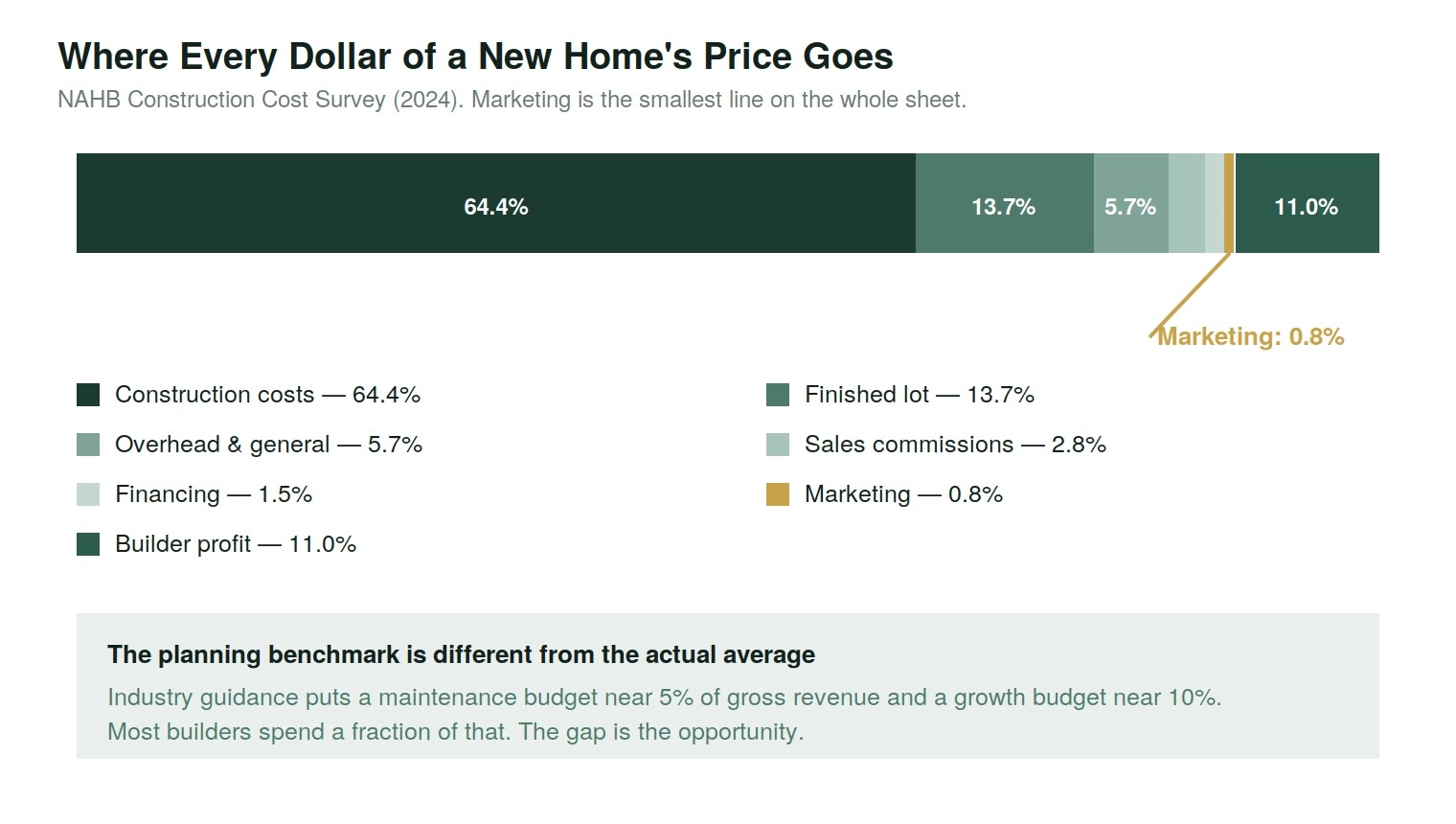
NAHB Construction Cost Survey (2024). Marketing is the smallest line on the sheet at 0.8 percent.
The full breakdown: construction costs 64.4 percent, finished lot 13.7 percent, builder profit 11.0 percent, overhead and general expenses 5.7 percent, sales commissions 2.8 percent, financing 1.5 percent, and marketing 0.8 percent.
Two things are worth noticing.
First, the benchmark and the reality are not close. A 5 percent planning benchmark against a 0.8 percent actual average is a six-fold gap. Some of that is definitional, the survey measures marketing cost as a share of an individual home’s sales price, while budget guidance is expressed against gross revenue, but no reasonable adjustment closes a gap that wide.
Second, builders can afford more than they spend. NAHB’s Cost of Doing Business Study (2025 edition) found single-family builders averaged a 20.7 percent gross profit margin and an 8.7 percent net profit margin in fiscal 2023, the highest net margin in more than three decades. The spread within that average is more revealing still: the top quartile of builders posted 17.7 percent net margins while the bottom quartile lost money at -1.4 percent.
Same economy. Same material costs. Same labour shortage. The difference is not luck.
The percentage rule, and when to break it
Percentage-of-revenue is a starting point, not an answer. Where you land inside the range depends on four things.
Your growth target. Holding steady with a full schedule justifies the low end, around 3 percent. Trying to add two projects a year, enter a new market, or move upmarket justifies the high end, 8-10 percent. Marketing spend is a function of the gap between where you are and where you want to be.
Your project size. A builder doing four $3M homes has different maths from one doing twenty $600K homes. Higher project values support higher acquisition costs per lead, because a single additional signed project pays for a great deal of marketing.
Your existing pipeline. A builder with fifteen years of referrals in a small market needs less than a builder who moved cities last year. Be honest about which one you are.
Your starting position. If you have no website worth the name, no Google Business Profile, and no reviews, your first year is a build year. Expect to spend above your steady-state percentage while you construct assets that will then work for years.
One caution about the percentage approach
A percentage of revenue is a backward-looking number applied to a forward-looking problem. In a soft year, revenue falls, the percentage produces a smaller budget, and marketing gets cut at precisely the moment you need pipeline most.
Custom home buying cycles frequently run twelve to eighteen months from first contact to signed contract. Cut marketing in a slow quarter and you are switching off the pipeline that would have filled the gap you are worried about, a year later, when you have no ability to fix it retroactively. Set the budget against your target revenue, not last year’s.
Dollar ranges by revenue band
These are planning ranges built from the percentage logic above and what a working programme costs to run properly.
| Annual revenue | Maintain (3-5 percent) | Grow (6-10 percent) | What the growth budget realistically buys |
|---|---|---|---|
| $1M – $3M | $30K – $150K | $60K – $300K | Website, local search, one paid channel, basic follow-up |
| $3M – $6M | $90K – $300K | $180K – $600K | The above, plus content, reputation programme, real reporting |
| $6M – $12M | $180K – $600K | $360K – $1.2M | Full multi-channel system, multiple markets, dedicated strategy |
| $12M+ | $360K+ | $720K+ | Everything above, plus brand and media production |
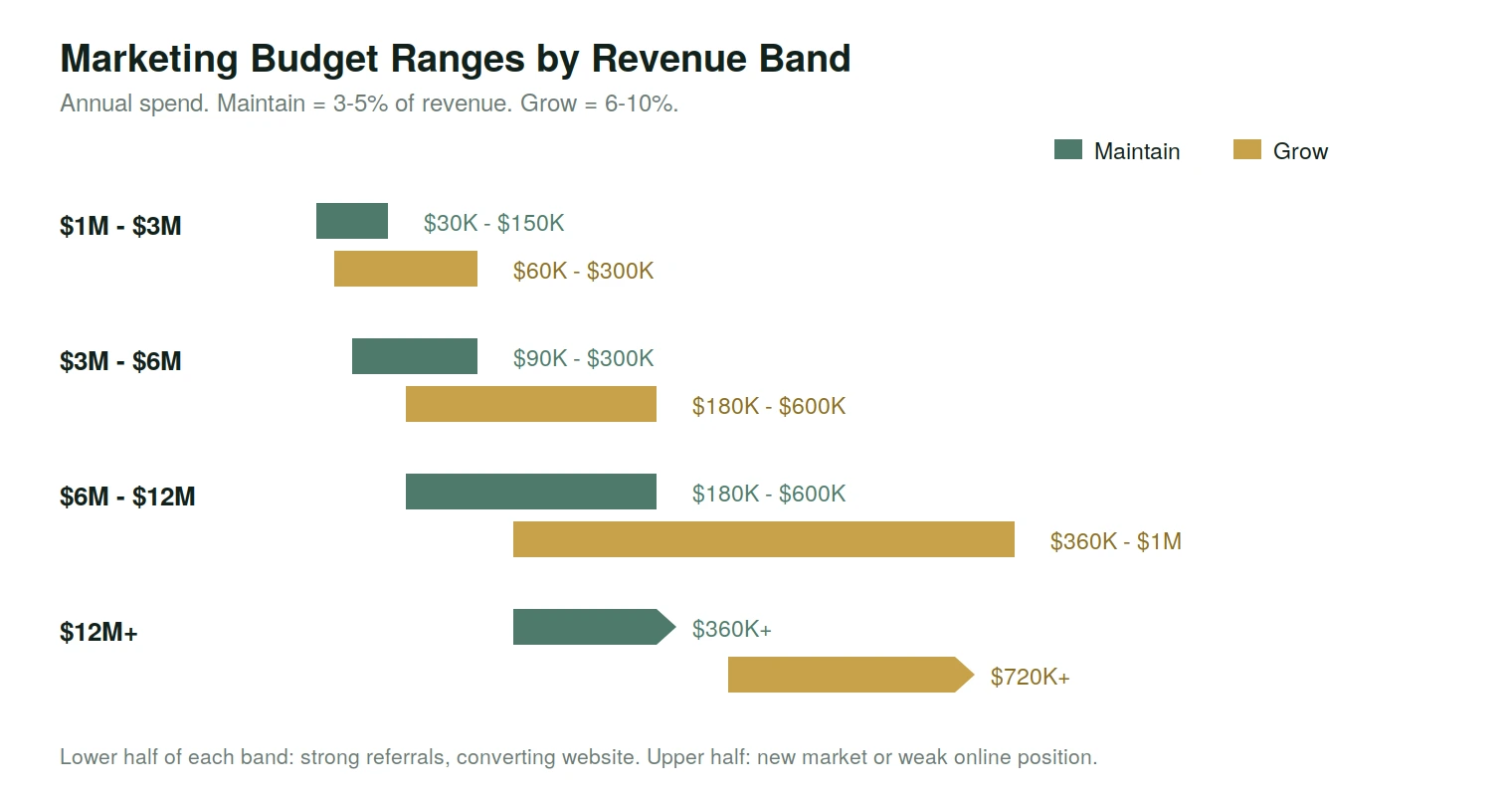
Annual marketing budget ranges by revenue band. Maintain = 3-5 percent of revenue, grow = 6-10 percent.
The ranges look wide because they are. A builder in a competitive metro pays more for the same visibility than one in a smaller market, and a builder starting from zero online spends more in year one than in year three.
Use the lower half of each band if you have strong referral flow, an established local reputation, and an existing website that converts.
Use the upper half if you are entering a new market, moving upmarket, starting from a weak online position, or competing in a metro with well-marketed rivals.
Not sure what your number should be?
Talk to us. We will look at your revenue, market and growth target and tell you what a realistic marketing budget looks like.
What each channel costs to run properly
Budget totals are less useful than knowing what you are buying. Rough monthly figures for a custom builder:
Website (one-off, $8K-$40K+). A real asset, not a monthly cost. The range reflects the difference between a competent template build and a custom site with project galleries, location pages and proper conversion architecture. Everything else you spend is routed through this, which is why underspending here quietly wastes every other line. See what a builder website needs to do.
Local search and Google Business Profile ($500-$2,000/month). Lowest-cost, fastest-payback line in most builder budgets. Covers profile optimisation, posts, photo management and local citation consistency.
SEO ($1,500-$6,000/month). Technical work, content production, location pages and authority building. The cost is front-loaded and the return is back-loaded, it is the only line where cost per lead falls over time. Our SEO service is built around that curve.
Google Ads ($2,000-$15,000/month in media, plus management). The most variable line. Clicks in high-value construction terms are expensive and volume is low, but one signed project against a year of spend is an excellent return. Budget for at least six months, shorter tests do not produce enough data to optimise against. More on digital ads for builders.
Reputation and reviews ($300-$1,500/month). Structured review generation and management. Disproportionate impact relative to cost, because a buyer about to spend $2M will read every review you have. Reputation work is closer to sales enablement than marketing.
Content and project documentation ($1,000-$5,000/month). Photography, case studies, written content. Feeds SEO, social proof and architect relationships simultaneously, which is why maximising the content value of each completed project is one of the highest-leverage things a builder can do.
Lead follow-up and CRM ($200-$1,500/month). The cheapest line with the highest return, because it protects everything the other lines produce. See lead generation and follow-up.
Reporting and attribution ($0-$1,000/month). Often bundled. Without it you cannot tell which of the above is working, which means next year’s budget is guesswork. Reporting is what turns marketing spend into a business decision.
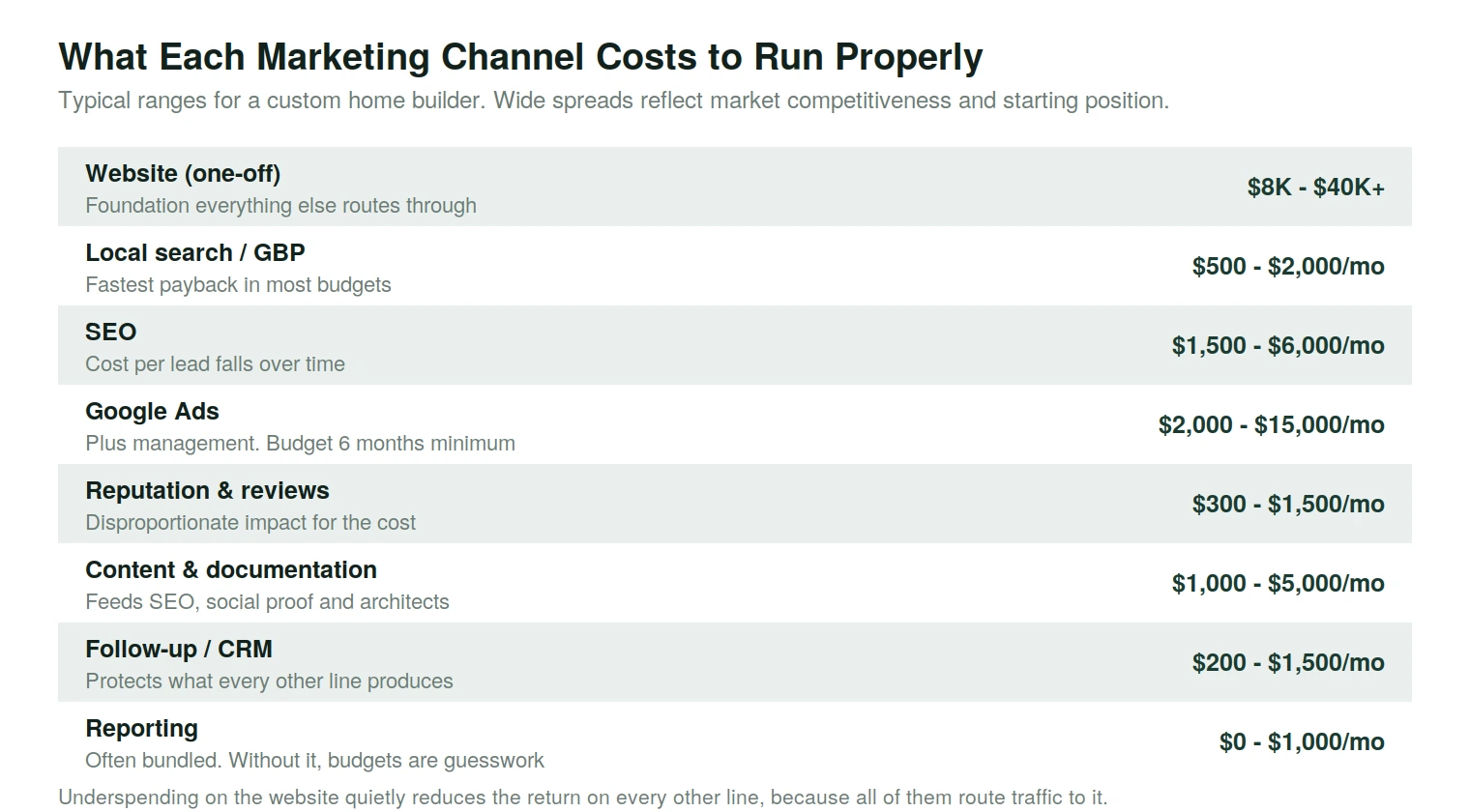
What each channel costs to run properly, and what it does for the rest of the budget.
How to know whether the budget is working
Three numbers matter, and none of them is website traffic.
Cost per signed project. Total marketing spend divided by projects signed from marketing sources. On a $1M-$5M build this figure can be surprisingly high and still excellent. If your annual marketing spend is $120,000 and it produced three signed projects at $1.8M average, you spent $40,000 to win $5.4M in revenue.
Lead-to-consultation rate. If enquiries are plentiful but consultations are rare, you have a qualification problem, not a volume problem, and more budget will make it worse.
Source attribution. Which channel produced each signed project. Most builders genuinely cannot answer this, which is why marketing budgets get cut arbitrarily rather than reallocated intelligently.
Judge each channel on its own timeline. Paid search should be assessed within a quarter. SEO cannot be fairly judged before month six. Applying a paid-search timeline to an SEO budget is the most common reason builders abandon the channel just before it starts working.
The bottom line
The benchmark is 5 percent of gross revenue to maintain and around 10 percent to grow. The industry average sits closer to 0.8 percent of a home’s sales price. Most builders are not overspending on marketing, they are underfunding the one function that determines whether they get to choose their projects or take what arrives.
The builders posting 17.7 percent net margins are not building better homes than the ones losing money. They are the ones who can turn demand up when they need to. That capability is bought, deliberately, with a budget set against target revenue rather than last year’s leftovers.
If you want a straight view of what your marketing should cost given your revenue, market and growth target, tell us where things stand. We will give you a real number, not a proposal.
Know What Your Marketing Should Cost
We work only with custom home builders. Book a call and we will give you a straight view of what your marketing should cost given your revenue, market and growth target.
Frequently Asked Questions
Q1. What percentage of revenue should a home builder spend on marketing?
Long-standing industry guidance suggests around 5 percent of gross projected revenue to maintain visibility and around 10 percent to grow and take market share. Custom builders defending a strong referral position can operate nearer 3 percent. The NAHB Construction Cost Survey shows actual marketing cost averaging just 0.8 percent of a home’s sales price, so most builders sit well below the planning benchmark.
Q2. Is marketing spend included in overhead for a home builder?
In NAHB’s cost breakdown, marketing is tracked as its own line separate from overhead and general expenses, and separate again from sales commissions. In practice many builders bury marketing inside general overhead, which makes it invisible and therefore the first thing cut in a soft quarter. Track it separately if you want to manage it.
Q3. How much should a custom home builder spend on a website?
Between roughly $8,000 and $40,000 as a one-off, depending on scope. The higher end reflects custom design, project galleries, location pages and conversion architecture. Because every other marketing channel routes traffic to the site, underinvesting here reduces the return on everything else you spend.
Q4. Should home builders spend on SEO or Google Ads first?
If you need leads inside 90 days, start with ads, it is the only channel that produces that quickly. If you are building a pipeline for next year, start with SEO and local search, because the cost per lead falls over time rather than rising. Most established builders should run both: ads for control, organic for compounding.
Q5. How much does home builder marketing cost per month?
For a builder doing $3M-$6M in annual revenue and pursuing growth, a realistic all-in monthly figure sits somewhere between $15,000 and $50,000 across all channels. For a $1M-$3M builder, $5,000 to $25,000 is a more typical range. The wide spread reflects market competitiveness and starting position more than anything else.
Q6. Can a small custom home builder afford to market properly?
Yes, if the budget is focused rather than spread thin. A builder doing $1.5M in revenue is better served spending $40,000 well on a website, Google Business Profile and follow-up systems than spreading $40,000 across six channels. Concentration beats coverage at small budgets.