
BUILDER INSIGHTS
Is SEO Worth It for Home Builders?
Yes, for most builders. Here is the honest version: what the return looks like, what it costs, and the four situations where we would tell you not to buy it.
ESTIMATED READ TIME: 8 MINUTES
Want to skip the reading? Speak directly with our Director of Growth Strategy.
Yes, for most custom home builders, SEO is worth it. It is the only marketing channel where cost per lead falls over time instead of rising, and buyers planning a $1M-$5M home research online for months before contacting anyone.
But it is not worth it for everyone, and it is not worth it in every situation. If you need leads inside 90 days, if you are unwilling to commit for at least nine months, or if your website cannot convert the traffic it already gets, SEO will waste your money. Those are real cases and we turn that work down.
This article gives you the honest version: what the return actually looks like, what it costs, how long it takes, and the four situations where you should spend the money elsewhere.
Why SEO fits custom home building unusually well
Three things about this industry make organic search a better fit than it is for most businesses.
The research period is extraordinarily long. A custom home buyer typically spends months, often a year or more, reading, comparing and shortlisting before they contact a builder. Almost all of that happens in search. They look up what it costs to build in their area, how long it takes, what to ask a builder, whether to hire an architect first. Every one of those searches is a chance to be the firm that answered them well.
The project values are enormous. In most industries, SEO has to produce a lot of leads to justify itself. Here, one additional signed project at $2M changes the economics of an entire year of marketing. You do not need volume. You need to be found by a handful of the right people.
The decision is trust-led, not price-led. People choosing who will build their home are trying to reduce risk. A builder whose website genuinely answers their questions is demonstrating competence in a way an advertisement cannot. This is also why what buyers find when they research you matters so much, the referral you were given still gets verified online.
What the return actually looks like
Here is the honest shape of it.
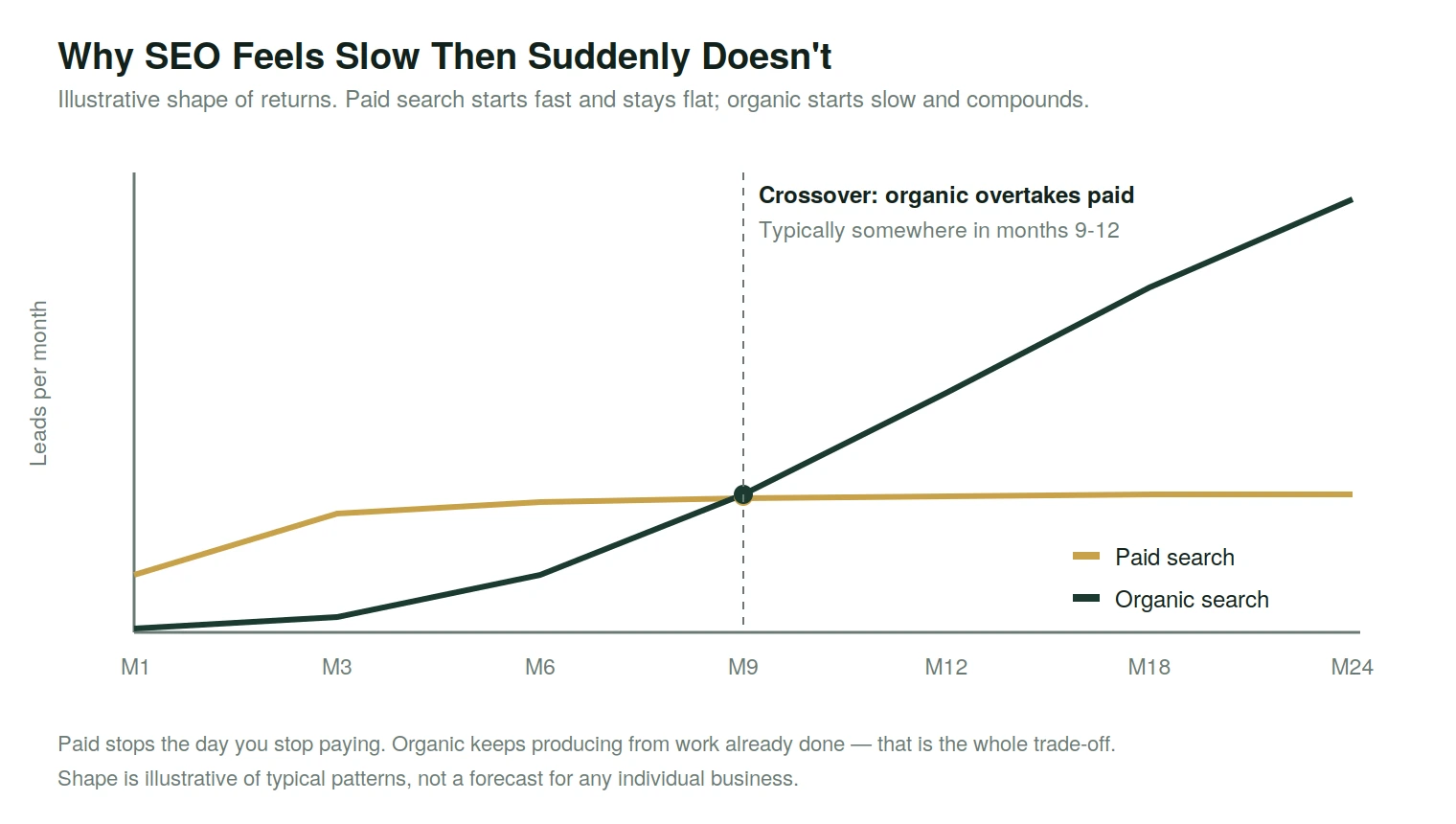
Paid search starts fast and stays flat. Organic starts slow and compounds. The crossover typically lands somewhere in months 9-12.
Paid search produces almost immediately and then plateaus, you get what you pay for, every month, forever. Organic search produces very little for months, then keeps climbing on work you already paid for.
The critical difference: paid stops the day you stop paying; organic does not. A service page or location page built in month three is still producing enquiries in year three at no additional cost. That is why the cost per lead falls, the numerator stops growing while the denominator keeps rising.
For a builder, this shows up as a specific and valuable business outcome. Once organic search is producing consistently, you can afford to say no. You are no longer bidding on every project that comes through the door because you need the work. That negotiating position is worth more than the leads themselves.
What SEO actually costs for a home builder
Realistic monthly figures sit between $1,500 and $6,000 depending on market competitiveness and starting position, with the first two to three months typically weighted higher because of foundational work.
What that buys, roughly:
Months 1-2, foundation. Technical audit and fixes, indexing problems, site structure, Google Business Profile optimisation, and tracking so results can actually be measured later. Nothing visible happens here, and this is where most builders lose patience.
Months 3-6, building. Service pages, location pages for the markets you build in, and content answering the questions buyers actually search. This is where the assets get created.
Months 6-12, compounding. Authority building, expanding into more competitive terms, and refining what is already working.
A useful comparison: a full year of SEO at $3,000/month is $36,000. Against a single signed $2M project at a typical builder gross margin, that spend is recovered many times over. The question is not whether the return is there, it is whether you will still be running the programme when it arrives.
Our SEO service for custom home builders is structured around this timeline specifically, with reporting that separates leading indicators from lagging ones so you can tell early whether it is on track.
Not sure whether SEO is right for you yet?
Talk to us. We will tell you straight, including when the honest answer is to fix something else first.
When SEO is NOT worth it for a home builder
We would rather tell you this now than take the engagement and disappoint you. Four situations where the answer is no.
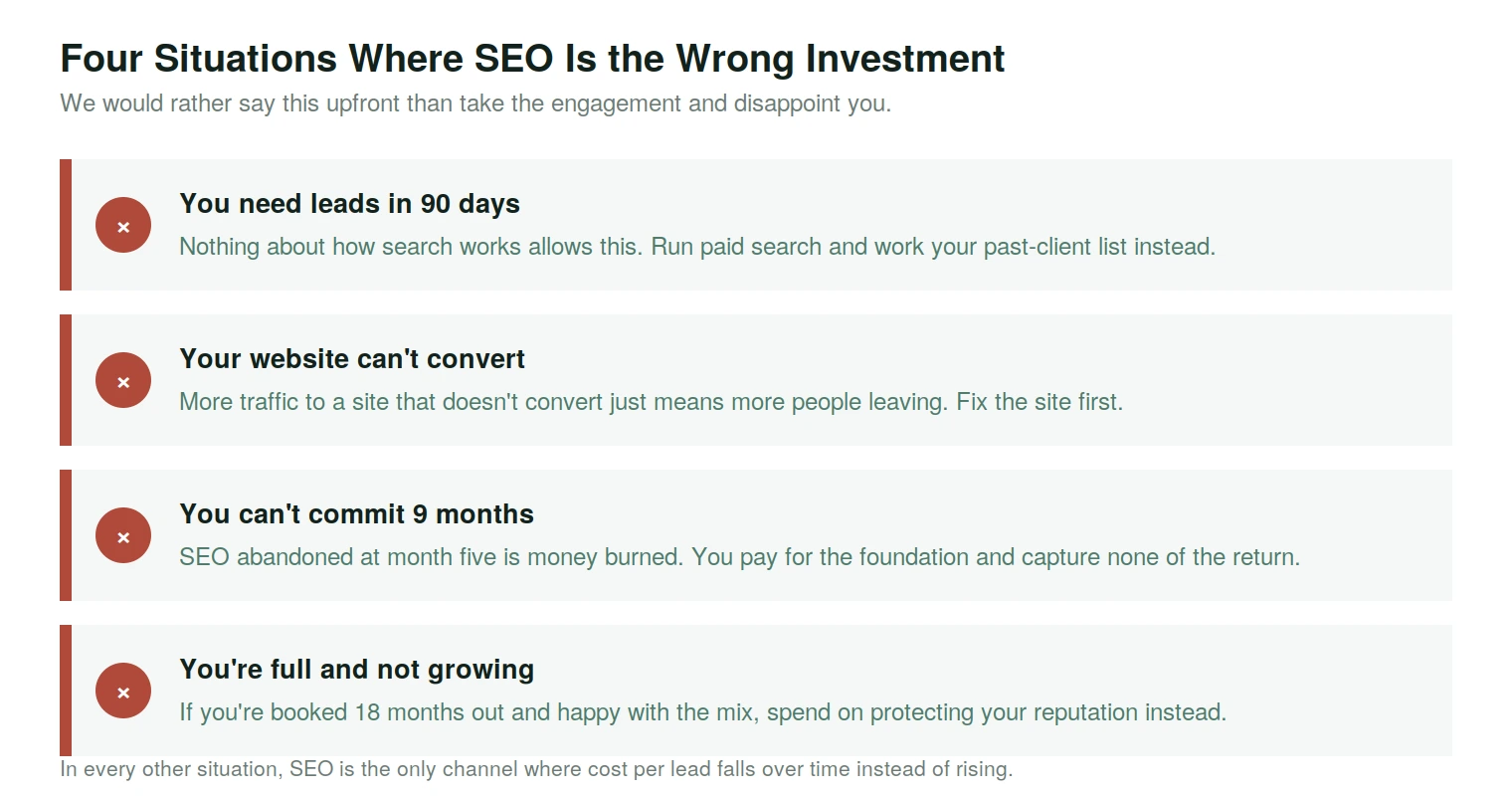
The four situations where we would tell a builder not to buy SEO.
1. You need leads in the next 90 days
SEO cannot do this. Nothing about the mechanism allows it, search engines need time to crawl, evaluate and re-rank pages, and competitive positions are not won in a quarter. If you have a hole in your schedule this spring, run paid search and work your past-client list. Start SEO alongside it, but do not expect it to solve the immediate problem.
2. Your website cannot convert the traffic it already gets
If your site does not clearly state what you build, where you build, roughly what projects cost, and how to start a conversation, sending more traffic to it changes nothing. You will pay to increase the number of people who leave.
Check this first. Look at your current enquiry rate from existing traffic. If it is close to zero, fix the website before you fund SEO. This is the single most common reason builder SEO campaigns “fail”, the traffic arrived and the site wasted it.
3. You cannot commit for at least nine months
SEO abandoned at month five is money burned. You will have paid for all of the foundational work and captured none of the compounding return. It is the worst possible outcome, worse than never starting, because you also spent the money.
If a nine to twelve month commitment is not realistic for your cash flow, wait until it is.
4. Your schedule is full and you have no intention of growing
If you are booked eighteen months out on referrals, genuinely happy with your project mix, and not trying to grow or move upmarket, SEO is a solution to a problem you do not have. Spend the money on protecting your reputation instead, that is what keeps referrals flowing.
The counterargument is worth hearing: builders who are full today and market anyway are the ones who stay full through a downturn. But that is a strategic bet, not an immediate return, and you should make it knowingly.
What good home builder SEO actually involves
Not all SEO is the same, and the version that works for builders is heavily weighted toward local and trust signals.
Local search foundations. Google Business Profile, consistent business information across the web, and location pages for the markets you genuinely build in. For a service business tied to geography, this is often worth more than everything else combined.
Service and location pages that say something. Six near-identical city pages with the place name swapped will not rank and may actively harm you. Pages need genuinely different content: local market conditions, real project examples, permitting realities in that jurisdiction.
Content matched to the buyer’s research. Cost questions, timeline questions, process questions, comparison questions. Not blog posts about why marketing matters, answers to what people actually type.
Demonstrated expertise. Google’s guidance on helpful content emphasises experience, expertise, authoritativeness and trustworthiness. For a builder, that means named people with real credentials, actual project documentation, and technical depth that a generalist could not fake. If you want the primary source, Google’s SEO Starter Guide and Search Essentials set out what search engines are looking for.
Technical soundness. Fast pages, correct structure, no indexing problems, working on mobile. Unglamorous and non-negotiable.
The bottom line
SEO is worth it for most custom home builders, for a specific reason: it is the only channel that makes you less dependent on paying for every lead. Over eighteen months it moves you from buying attention to owning it.
But it is a nine-to-twelve month commitment with almost nothing to show for the first quarter, and it only works if the website receiving the traffic can convert it. If you cannot commit to that timeline, or your site is not ready, spend the money on paid search and fix the foundations first. That is the honest advice, even though it is not the advice that sells an SEO engagement.
If you want a straight assessment of whether SEO makes sense for your firm, including a genuine “not yet” if that is the answer, tell us where your marketing stands.
Find Out If SEO Is Worth It for You
We work only with custom home builders. Book a call for a straight assessment, including a genuine answer if the timing is wrong.
Frequently Asked Questions
Q1. Is SEO worth it for small home builders?
Often more so than for large ones. A small builder needs perhaps three to eight additional projects a year, and local search can realistically deliver that. Smaller builders also compete in less contested local markets, so ranking is achievable on a modest budget. The constraint is commitment, not company size, you need to sustain the investment for nine to twelve months.
Q2. How much does SEO cost for a home builder?
Typically $1,500 to $6,000 per month, with the first two or three months often weighted higher for foundational work. The range reflects market competitiveness and starting position. A builder in a large metro competing against well-marketed rivals sits at the top of that range; a builder in a smaller market with a sound existing website sits at the bottom.
Q3. Is SEO better than Google Ads for home builders?
Neither is better, they solve different problems. Ads produce leads within weeks and stop when you stop paying. SEO takes months and keeps producing from work already done. Ads give you control over timing; SEO gives you cost efficiency over time. Most established builders should run both, with ads filling schedule gaps and organic building the underlying pipeline.
Q4. How do I know if SEO is working for my construction company?
Watch leading indicators before lagging ones. In months 1-3, look for indexing improvements and rising impressions in Google Search Console. By months 4-6, look for non-brand keyword rankings and early enquiries. By months 6-12, judge it on qualified leads and signed projects. If impressions are not moving by month four, something is wrong, that is your early warning signal.
Q5. Can I do SEO for my building company myself?
Some of it, yes. Claiming and optimising your Google Business Profile, gathering reviews consistently, and documenting projects properly are all achievable in-house and produce real results. Technical SEO, competitive content strategy and authority building are harder to do part-time, and the most common outcome of DIY SEO is a stalled effort at month four, which costs more in lost time than it saved in fees.
Q6. Will AI search replace SEO for home builders?
It changes how the work is done, not whether it matters. Answer engines and AI overviews still draw from indexed web content, and they favour pages that answer questions directly, cite specifics and demonstrate genuine expertise. A builder whose site clearly answers what a custom home costs in their market is more likely to be surfaced by an AI assistant, not less. The fundamentals, clear content, technical soundness, real authority, apply to both.