
BUILDER INSIGHTS
How Long Does SEO Take for a Construction Company?
Four to twelve months, and that is Google’s own guidance rather than an agency hedge. Here is what happens in each phase, and what to measure when.
ESTIMATED READ TIME: 8 MINUTES
Want to skip the reading? Speak directly with our Director of Growth Strategy.
SEO typically takes four to twelve months for a construction company to see meaningful results. Early technical signals appear within four to eight weeks, first qualified leads usually arrive between months four and six, and consistent pipeline contribution generally lands somewhere between months nine and twelve.
That range is not us hedging. It matches Google’s own long-standing guidance. A Google search representative put it plainly some years ago and it has never been contradicted: in most cases, SEO work needs four months to a year to first implement improvements and then show potential benefit. Google’s documentation makes a similar point, some changes take effect in hours, others take months, and you generally want to wait several weeks before assessing whether work had an effect.
Anyone promising a construction company page-one rankings in 30 days is either targeting keywords nobody searches or doing something that will cost you later.
Below is what actually happens in each phase, why construction is slower than some industries, and what makes the difference between the fast end of that range and the slow end.
The realistic month-by-month timeline
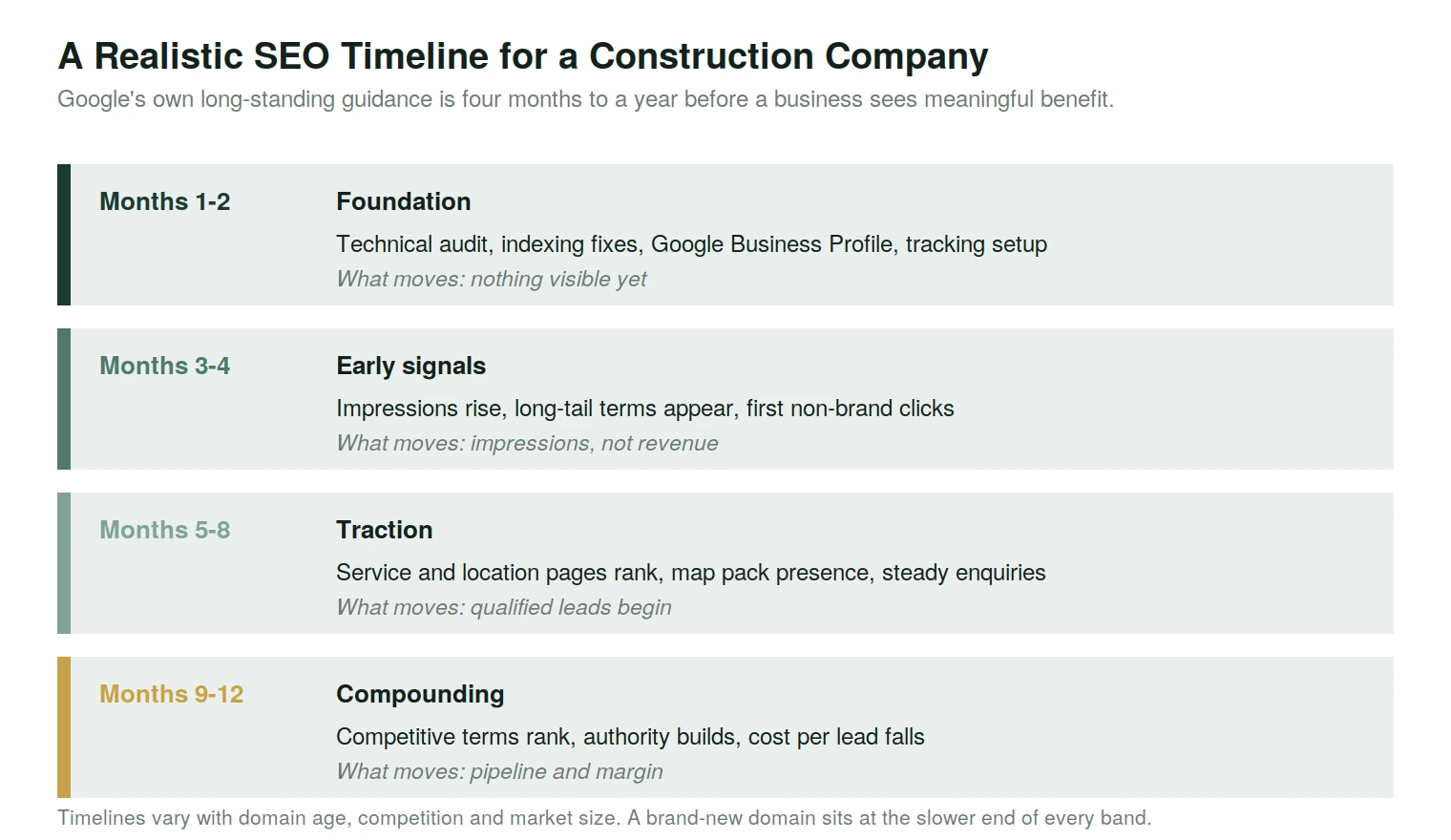
A realistic SEO timeline for a construction company. Timelines vary with domain age, competition and market size.
Months 1-2: Foundation (nothing visible happens)
Technical audit and fixes, indexing problems resolved, site structure corrected, Google Business Profile optimised, tracking and analytics configured properly so results can be measured later.
What moves: Nothing you would notice. Possibly some early gains if the site had obvious problems, a site starting from close to zero optimization can see a meaningful initial jump simply from fixing what was broken.
Where builders go wrong: Expecting rankings. This phase is plumbing. It feels like paying for nothing, and it determines whether everything after it works.
Months 3-4: Early signals
Content and pages built in phase one begin to be crawled and evaluated. Long-tail terms, longer, more specific searches with less competition, start appearing.
What moves: Impressions in Google Search Console rise. A handful of non-brand clicks appear. Rankings show up on page three or four for terms you care about, which feels like nothing but is the correct trajectory.
The signal to watch: If impressions are not climbing by the end of month four, something is wrong. That is your early warning, and it arrives long before lead data would.
Months 5-8: Traction
Service pages and location pages start ranking on page one for less competitive terms. Map pack visibility improves for local searches.
What moves: First genuinely attributable enquiries. Volume is modest and inconsistent, two enquiries one month, none the next, five the following. That volatility is normal and not a sign of failure.
What to judge here: Lead quality, not quantity. If the enquiries arriving are the right project size in the right locations, the targeting is correct and volume will follow.
Months 9-12: Compounding
Competitive commercial terms start ranking. Authority accumulates. Pages built in month three are now producing steadily on their own.
What moves: Consistent monthly lead flow, falling cost per lead, and organic overtaking paid as a lead source in most cases.
What changes for the business: This is the point where you can start declining projects. The pipeline stops depending on whether you spent money that month.
Why construction is slower than some industries
Four structural reasons, worth understanding so the timeline does not feel arbitrary.
Long buyer research cycles. A homeowner planning a custom build researches for months before contacting anyone. Even when you rank in month five, the person who finds you may not enquire until month nine and may not sign until the following year. The ranking arrives before the revenue by a considerable margin.
High-value, low-volume keywords. Construction search terms have modest volume and intense competition, because every competitor knows a single lead is worth a lot. Fewer searches means slower data accumulation, which means slower optimisation.
Local competition is entrenched. The builders ranking in your market have often held those positions for years and accumulated trust signals over that time. Displacing an established local competitor takes longer than ranking for something new.
Trust signals take time to build. Google’s guidance emphasises experience, expertise, authoritativeness and trustworthiness, and for a business asking someone to spend $2M, that bar is high. Reviews, project documentation and credible authorship accumulate over months, not weeks.
What makes SEO faster or slower
Six factors decide where you land in the four-to-twelve-month range.
| Factor | Faster end | Slower end |
|---|---|---|
| Domain age | Established site with history | Brand-new domain |
| Existing site quality | Sound technical foundation | Broken indexing, thin pages |
| Market competitiveness | Smaller regional market | Major metro with well-marketed rivals |
| Content production rate | Consistent monthly publishing | Sporadic or stalled |
| Local presence | Claimed profile, steady reviews | No profile, few reviews |
| Scope of work | Focused on a few markets | Many locations at once |
Two of these are worth expanding.
A brand-new domain sits at the slow end of every band. Search engines take time to establish trust in a site with no history. This is not a penalty, just a lack of accumulated evidence. If your site launched recently, plan for the twelve-month end of the range rather than the four-month end.
Existing technical problems reset the clock. Indexing errors, duplicate content, or pages competing with each other for the same term will hold a site back regardless of how good the content is. Fixing them is unglamorous and produces the fastest wins available, which is why competent programmes start there.
Want a timeline for your actual situation?
Talk to us. We will look at your domain, market and starting position and give you a realistic range rather than a generic one.
What to measure, and when
The most common cause of an abandoned SEO programme is measuring the wrong thing at the wrong time. Use this instead.
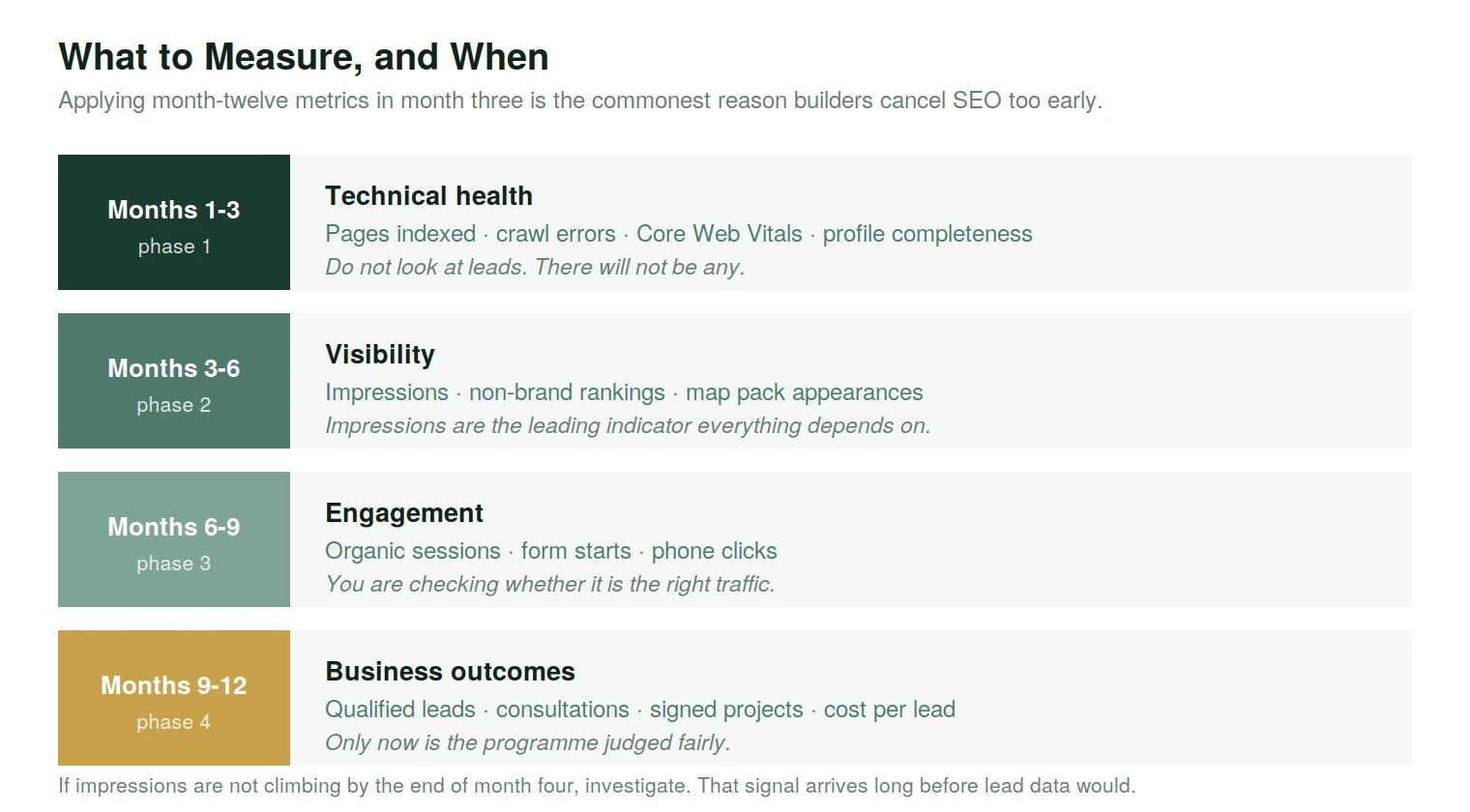
What to measure in each phase. Judging month-twelve metrics in month three is why builders cancel too early.
Months 1-3, technical health. Pages indexed, crawl errors resolved, Core Web Vitals, Google Business Profile completeness. Do not look at leads. There will not be any.
Months 3-6, visibility. Impressions, non-brand keyword rankings, map pack appearances. Impressions are the leading indicator that everything downstream depends on.
Months 6-9, engagement. Organic sessions, pages per session, form starts, phone clicks. You are checking whether the traffic is the right traffic.
Months 9-12, business outcomes. Qualified leads from organic, consultations booked, projects signed, cost per lead. This is where the programme is finally judged fairly.
Applying month-twelve metrics in month three is the single most common reason builders cancel SEO just before it starts working. Proper reporting separates these phases so you can tell early whether the programme is on track without waiting a year to find out.
Can you speed it up?
To an extent, yes, and only in legitimate ways.
Fix technical problems first. Indexing issues, duplicate pages and internal linking gaps unblock everything downstream. These are the fastest wins in SEO, full stop.
Improve pages that already have impressions. A page ranking on page two is far closer to producing than a page that does not exist. Strengthening existing near-miss pages beats publishing new ones early on.
Prioritise local search. Google Business Profile optimisation and review generation can produce visible results in two to eight weeks, dramatically faster than organic rankings. For a construction company, this is the fastest legitimate route to search-driven leads.
Run paid search alongside. This does not accelerate SEO, but it produces leads during the months when organic is still building. It also generates keyword data that improves your organic targeting. See digital ads for builders.
Publish consistently. A site adding useful content monthly will outpace one publishing in bursts. Consistency is a bigger lever than volume.
What will not speed it up: buying links, mass-producing thin location pages, or any agency promising rankings on a schedule. Those tactics cost more to undo than they ever produce.
The bottom line
SEO for a construction company takes four to twelve months. That is not an agency hedge; it is Google’s own long-standing guidance and it matches what we see running these programmes for builders.
The failure mode is almost never that SEO does not work. It is that the programme gets judged on lead volume in month three, when the only honest thing to measure is whether impressions are climbing. Builders who understand the phases stay the course and reach the compounding period. Builders who do not cancel at month five, having paid for all the foundation work and captured none of the return.
If you want a realistic timeline for your specific market, domain and starting position, rather than a generic promise, tell us where your marketing stands. We will tell you what to expect and when, including if the honest answer is that you should wait.
Read next: Is SEO worth it for home builders?
Get a Realistic Timeline for Your Market
We work only with custom home builders and construction firms. Book a call and we will give you a timeline based on your domain, market and starting position.
Frequently Asked Questions
Q1. How long does SEO take to show results for a construction company?
Four to twelve months for meaningful results. Technical improvements and Google Business Profile optimisation can show effects within four to eight weeks. First attributable leads typically arrive between months four and six. Consistent, reliable pipeline contribution usually lands between months nine and twelve. Google’s own guidance has long put the window at four months to a year.
Q2. Why is my construction company SEO taking so long?
The most common causes are a brand-new domain with no history, unresolved technical problems such as indexing errors or duplicate content, thin location pages that cannot rank, inconsistent content publishing, and a competitive metro market with entrenched local rivals. If impressions in Search Console are not rising by month four, investigate rather than wait, that is the earliest reliable signal that something is wrong.
Q3. How long before SEO generates leads for a home builder?
Typically months four to six for the first attributable enquiries, and months nine to twelve for consistent monthly flow. Local search leads through Google Business Profile can arrive considerably sooner, sometimes within two months, because map pack visibility responds faster than organic rankings.
Q4. Is six months long enough to judge SEO?
It is long enough to judge whether the programme is on track, not long enough to judge its full return. By month six you should see rising impressions, page-one rankings for less competitive terms, and early enquiries. If none of those are present, something is wrong. If they are present, the compounding phase has not happened yet and cancelling now forfeits the return you already paid for.
Q5. Does SEO work faster for local construction companies?
Local SEO generally produces faster than national organic SEO. Google Business Profile optimisation, review generation and local citation work can move within weeks rather than months. For a construction company serving defined geographic markets, local search is both the fastest and the highest-value place to start.
Q6. How long does SEO take for a new construction website?
Longer than for an established site, plan for the nine-to-twelve-month end of the range, and potentially beyond in a competitive metro. A new domain has no accumulated trust or link history, so search engines take longer to evaluate it. Local search and paid advertising are the practical ways to generate leads during that build period.