
BUILDER INSIGHTS
How Do Custom Home Builders Get Leads?
Nine channels, compared on what each one costs, how fast it produces, and how much control you actually have over it.
ESTIMATED READ TIME: 10 MINUTES
Want to skip the reading? Speak directly with our Director of Growth Strategy.
Custom home builders get leads from nine main channels: referrals from past clients, Google Business Profile and local search, organic search (SEO), Google Ads, architect and trade partnerships, job-site signage, project content and social media, online directories, and structured email follow-up. Most builders rely almost entirely on the first one, which is exactly why their pipeline feels unpredictable.
That unpredictability is the real problem. It is rarely a shortage of interest. It is that every lead arrives by accident, at a time you did not choose, from a source you cannot increase on demand.
This article breaks down all nine channels: what each one costs, how long it takes to produce a first inquiry, how much control it gives you, and which ones are worth your attention if you build $1M-$5M custom homes. We have run these channels for builders across the country, and the honest answer is that some of them are far better than their reputation and some are far worse.
Why referrals stop being enough
Nearly every custom builder starts on referrals, and for a while it works beautifully. The work is good, clients tell their friends, and the phone rings.
The problem is not that referrals are bad leads. They are usually the best leads you will ever get. The problem is three structural limits:
You cannot turn them up. When a project falls through in March and you have a hole in your schedule, there is no lever to pull. Referrals arrive on their own schedule.
They arrive already compared. A referred homeowner will still search your name, look at your website, read your reviews, and often look at two other builders before calling. If what they find online does not match what they were told, the referral leaks. This is why a strong digital presence matters even for word-of-mouth leads.
They scale with your past, not your future. Referral volume reflects the number of homes you finished two years ago. If you want to grow beyond that, referrals mathematically cannot take you there.
Referrals should stay your best channel. They just cannot be your only one.
The nine lead channels, compared
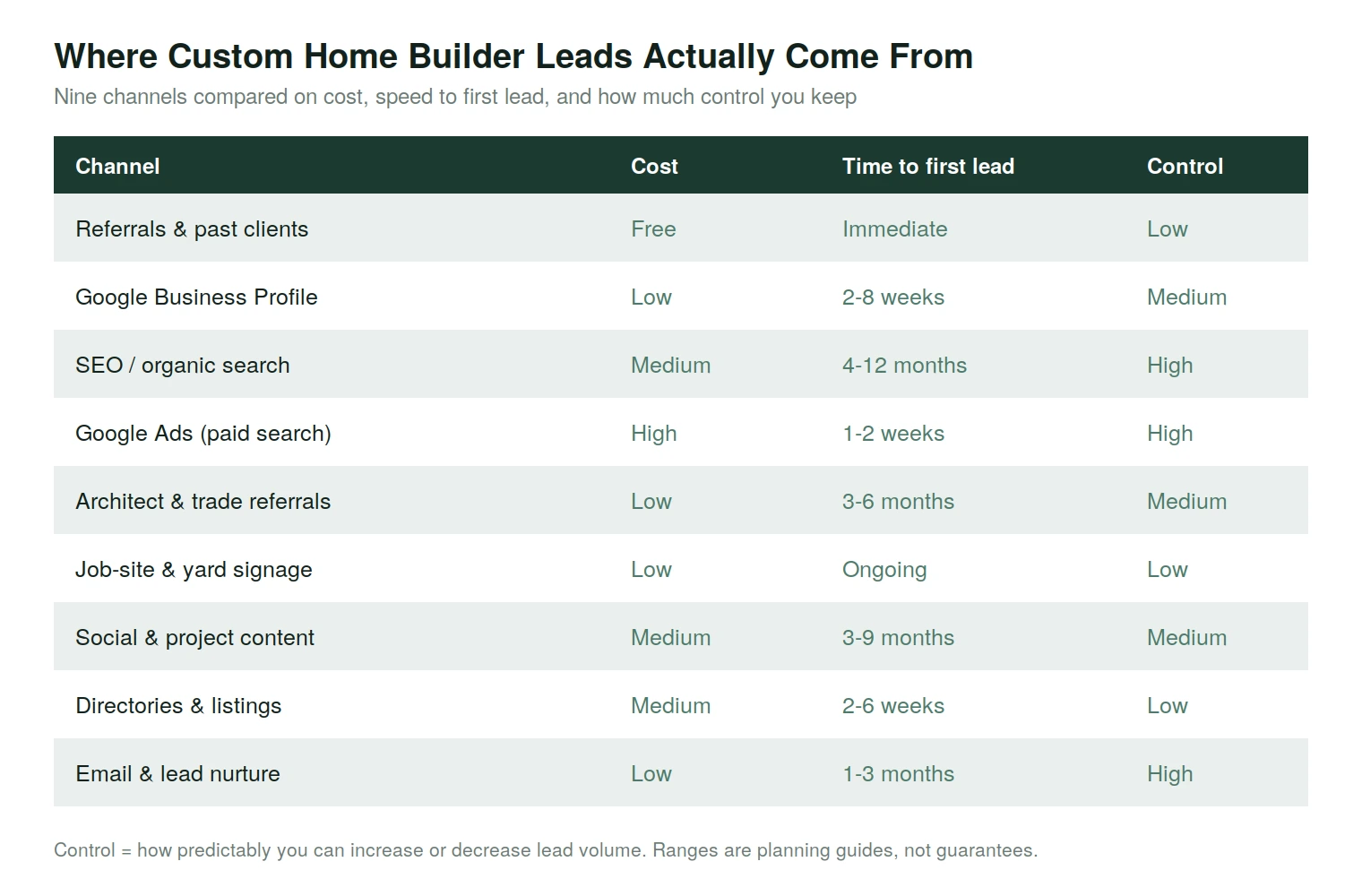
Where custom home builder leads actually come from, nine channels compared on cost, speed and control.
1. Referrals and past clients
Cost: Effectively free · Time to first lead: Immediate · Control: Low
Highest close rate, shortest sales cycle, lowest cost. Also the least controllable.
The one thing most builders miss: referrals can be prompted. A structured past-client programme, a check-in at twelve months, a project anniversary note, a simple “who else do you know who is planning a build” ask at handover, reliably increases referral volume. Most builders never ask, then describe referrals as unpredictable.
2. Google Business Profile and local search
Cost: Low · Time to first lead: 2-8 weeks · Control: Medium
This is the single most underused channel in custom home building, and the fastest source of qualified local enquiries.
When someone searches “custom home builder near me” or “luxury home builder your city“, Google shows a map with three business listings above the normal results. Appearing there depends heavily on your Google Business Profile: correct category, complete service list, real project photos, current hours, and a steady flow of reviews.
Builders consistently underestimate this because it feels administrative. It is not. For a local, high-value service, map pack visibility is often worth more than the entire rest of the website.
3. Organic search (SEO)
Cost: Medium · Time to first lead: 4-12 months · Control: High
Buyers planning a custom home search for months before they contact anyone. They search things like “cost to build a custom home in city“, “custom builder vs general contractor”, “how long does it take to build a custom home”.
SEO puts you in front of that research. It is slow to start and it compounds, the pages you build in month three are still producing enquiries in year three. It is the only channel where the cost per lead falls over time instead of rising.
The trade-off is honest: nothing happens quickly. If you need a lead this month, this is not the channel. If you want a pipeline in eighteen months that does not depend on ad spend, it is the most important one. Our SEO service for custom home builders is built specifically around this timeline.
4. Google Ads and paid search
Cost: High · Time to first lead: 1-2 weeks · Control: High
Paid search buys you the top of the results page immediately. For builders, it works best in two situations: filling a specific schedule gap, and targeting high-intent commercial searches where a single closed project pays for a year of ad spend.
The maths in custom home building is unusual. Clicks are expensive and volume is low, but one signed $2M project against even $30,000 of annual ad spend is an outstanding return. The risk is not cost per click, it is spending on unqualified traffic. Tight targeting and a landing page that filters hard matter more than budget size.
Paid stops producing the day you stop paying. That is not an argument against it; it is an argument for running it alongside organic search rather than instead of it. See our approach to digital ads for builders.
5. Architect, designer and trade referrals
Cost: Low · Time to first lead: 3-6 months · Control: Medium
The most valuable and most neglected channel in high-end custom building.
Architects control which builders get invited to bid. A single architect relationship can be worth several projects a year, for years. Interior designers, landscape architects, structural engineers and high-end realtors all sit in the same position.
These relationships are earned through demonstrated technical competence, not networking lunches. Documenting how you handle a complex envelope detail or a difficult site does more to win an architect than any pitch, which is the practical case for turning your completed projects into content.
6. Job-site signage and physical presence
Cost: Low · Time to first lead: Ongoing · Control: Low
Cheap, still works, still underrated in affluent neighbourhoods where neighbours are your exact target buyer.
The mistake is a sign with only a logo and phone number. A sign with a short, specific message and an easy way to look you up converts far better, because the neighbour who notices it will search your name later that evening, not call from the sidewalk.
7. Project content and social media
Cost: Medium · Time to first lead: 3-9 months · Control: Medium
Social media rarely produces a cold lead for a custom builder. What it does exceptionally well is close leads that came from somewhere else.
A referred homeowner who finds a well-documented body of work, process, materials, finished results, the reasoning behind decisions, arrives at the first meeting already convinced. Treat social as proof infrastructure rather than a lead source and it earns its keep.
Photography alone is not enough. Every builder has good photos; what separates the ones who win premium work is the story around them.
8. Online directories and listing platforms
Cost: Medium · Time to first lead: 2-6 weeks · Control: Low
Directories deliver volume quickly and quality inconsistently. Leads are typically shared with several builders, price-focused, and often below your minimum project size.
They can be worth running as a supplement if you qualify hard and track cost per closed project rather than cost per lead. They should never become your primary channel, because you are renting the relationship rather than owning it, and the platform can change the terms whenever it likes.
9. Email and structured lead follow-up
Cost: Low · Time to first lead: 1-3 months · Control: High
This is not really a lead source. It is the reason your other channels work.
A custom home buyer’s decision cycle frequently runs twelve to eighteen months from first contact to signed contract. Most builders respond once, hear nothing, and move on. The enquiry that went quiet in February signs with someone else in November, usually whoever stayed in touch.
Automated, genuinely useful follow-up is the highest-return, lowest-cost thing most builders can fix. It is the core of our lead generation service.
Not sure which channels fit your business?
Talk to us. We will look at where your leads come from today and which two or three channels are worth your attention next.
Which channels should you start with?
You do not need all nine. You need the right two or three for your situation.
| Your situation | Start with | Why |
|---|---|---|
| Schedule gap in the next 90 days | Google Ads + past-client outreach | Only channels that produce inside a quarter |
| Steady work, want predictability | Google Business Profile + SEO | Builds a pipeline you control |
| Strong locally, want bigger projects | Architect relationships + project content | Reaches the people who specify builders |
| Plenty of leads, wrong leads | Website + follow-up systems | The problem is qualification, not volume |
| Starting from nothing online | Website + Google Business Profile | Everything else depends on these two |
Two rules hold across all of them.
Fix the destination before you drive traffic to it. Every channel above sends people to your website. If that site does not clearly show what you build, where you build, what projects cost, and how to start a conversation, every channel underperforms. A website built to convert is not a separate project from lead generation, it is the foundation of it.
Track cost per closed project, not cost per lead. A channel producing leads at $80 each that never close is worse than one producing leads at $600 each that close one in five. Most builders cannot tell the difference because nothing is measured, which is why attribution and reporting matter more in this industry than in almost any other.
What a working lead system looks like
The builders with genuinely predictable pipelines are not doing anything exotic. They run four things at once:
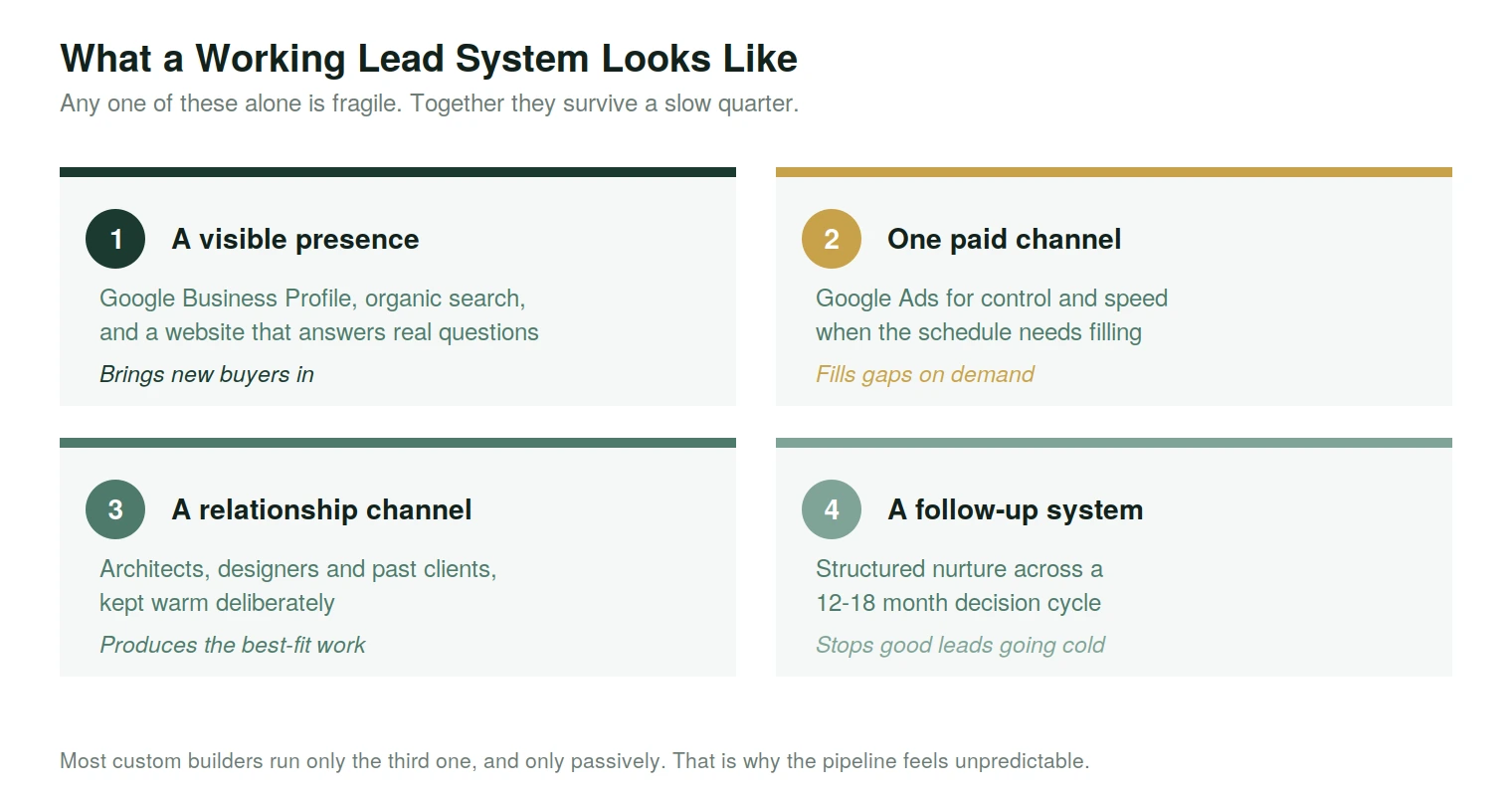
The four components of a lead system that keeps producing through a slow quarter.
- A visible presence: Google Business Profile, organic search and a website that answers real buyer questions
- One paid channel: for control and speed when the schedule needs filling
- A relationship channel: architects, designers, past clients, kept warm deliberately
- A follow-up system: so nothing goes cold during a twelve-month decision cycle
Any one of those alone is fragile. Together they produce a pipeline that survives a slow quarter.
The bottom line
Custom home builders get leads from nine channels, but almost every builder gets them from one. That is the whole problem, not a lack of demand, but a lack of levers.
The fix is not to chase every channel. It is to add two or three that you control, connect them to a website that converts, and stop letting good enquiries go cold during a long decision cycle. That is what turns an unpredictable schedule into a booked one.
We work only with custom home builders, and we build these systems end to end. If you want a straight assessment of where your leads come from today and which channel would move the needle fastest, tell us where your marketing stands. No pitch, just a clear answer.
Build a Pipeline You Control
We work only with custom home builders, and we build these systems end to end. Book a call and we will map the two or three channels that fit your business.
Frequently Asked Questions
Q1. How many leads does a custom home builder need per year?
Far fewer than most builders assume. At a typical close rate of 10-20 percent on qualified enquiries, a builder doing six to eight custom homes a year needs roughly 40-80 genuinely qualified leads annually, three to seven a month. The goal is qualification, not volume. A hundred unqualified enquiries is worse than fifteen good ones, because unqualified leads consume estimating time you cannot bill for.
Q2. What is the best lead source for custom home builders?
Referrals close at the highest rate, but organic search and Google Business Profile produce the most controllable leads. The strongest position combines them: local search brings new buyers in, and a strong reputation converts them at referral-like rates. Ranking channels by close rate alone misleads, because it ignores whether you can increase volume when you need to.
Q3. How much do custom home builder leads cost?
It varies enormously by channel. Referrals are effectively free. Organic search has a high upfront cost that falls over time. Paid search typically runs highest per lead but delivers immediately. Rather than benchmarking cost per lead, track cost per signed project, on a $1M-$5M build, almost any acquisition cost is defensible if the lead closes.
Q4. Do online directories work for custom home builders?
They generate volume, not necessarily quality. Leads are usually shared with competitors and skew toward price-shopping. They can work as a supplementary channel with hard qualification, but they are a poor foundation because you never own the relationship or control the terms.
Q5. How long does it take to build a predictable lead pipeline?
Roughly six to twelve months for a system that produces consistently. Quick channels like paid search and past-client outreach can produce within weeks. Compounding channels like SEO and architect relationships take longer but produce the leads worth having. Anyone promising a predictable pipeline in 30 days is selling volume, not projects.
Q6. Why aren’t my leads turning into signed contracts?
Usually one of three things: the leads are not qualified for your project size, your follow-up stops too early for a twelve-to-eighteen-month decision cycle, or your online proof does not match your in-person credibility. A homeowner about to spend $2M will research you thoroughly, and thin or inconsistent reviews and reputation will lose you the job before you ever meet.