
REFERRALS
How Custom Home Builders Get More Referrals From Architects and Designers
The best custom home projects often start with an architect’s recommendation. Here is how to earn steady referrals from architects and designers on purpose, not by luck.
ESTIMATED READ TIME: 11 MINUTES
Want to skip the reading? Speak directly with our Director of Growth Strategy.
Ask most established custom home builders where their best projects come from, and you’ll often hear the same answer: “An architect sent them to us.”
It makes sense. Architects and interior designers often meet clients months before a builder does. They know the budget, the lot, and the vision. When they recommend a builder, the client usually listens, because they’ve already trusted that architect with their home’s design.
Yet most builders treat these referrals as luck. Some architects send work, some don’t, and nobody’s quite sure why. The builders who get steady referrals from design professionals usually aren’t lucky. They’ve built relationships on purpose, made themselves easy to recommend, and given their partners reasons to keep sending clients their way.
This guide shows you how to do the same, from choosing the right partners to co-marketing finished homes and making referrals easy.
The short answer: Custom home builders get more referrals from architects and designers by protecting their design intent, communicating well during projects, giving them public credit for shared work, co-marketing finished homes, staying in regular touch with useful value (not sales pitches), and making the referral handoff simple and reliable.
Why Architect and Designer Referrals Are So Valuable
Referrals from design professionals are often the highest-quality leads a custom builder can get. Here’s why:
- The client is already pre-qualified. By the time an architect recommends you, the client usually has land, a budget conversation underway, and a design in progress.
- Trust transfers. The client trusts their architect. A recommendation borrows some of that trust for you.
- The fit is usually better. Architects tend to recommend builders whose quality and style match the homes they design.
- Relationships repeat. One good partnership can produce a steady stream of projects over many years.
- It supports your reputation everywhere else. Being the builder that respected architects choose is a powerful message on your website, in proposals, and in local media.
The same is true for interior designers, landscape architects, and other design professionals who work with your ideal clients.
What Architects and Designers Look for in a Builder
Before you can earn referrals, it helps to understand what’s at stake for the architect. When they recommend a builder, their own reputation is on the line. If the project goes badly, the client remembers who suggested you.
Design professionals typically look for builders who:
- Respect and protect the design. They want the finished home to look and work the way it was designed, without unexplained shortcuts or substitutions.
- Communicate clearly and early. They want to hear about problems, cost issues, and change requests before they become surprises.
- Give honest, early budget input. A builder who helps keep a design within budget during design development saves everyone pain later.
- Value their role. They don’t want to be cut out of decisions or have the builder go around them to the client.
- Build with quality and care. Details, finishes, and craftsmanship reflect on the architect as much as on you.
- Run organized, professional jobsites. Clean sites, clear schedules, and reliable subcontractors make the client experience better for everyone.
- Make them look good. Ultimately, they want the client to be thrilled with the home and with the team they recommended.
If you can deliver on these consistently, referrals tend to follow. If you can’t, no marketing plan will fix it.
The Referral Cycle: How One Project Leads to the Next
The strongest builder and architect partnerships work like a cycle. Each good project creates the material, trust, and visibility that lead to the next referral.
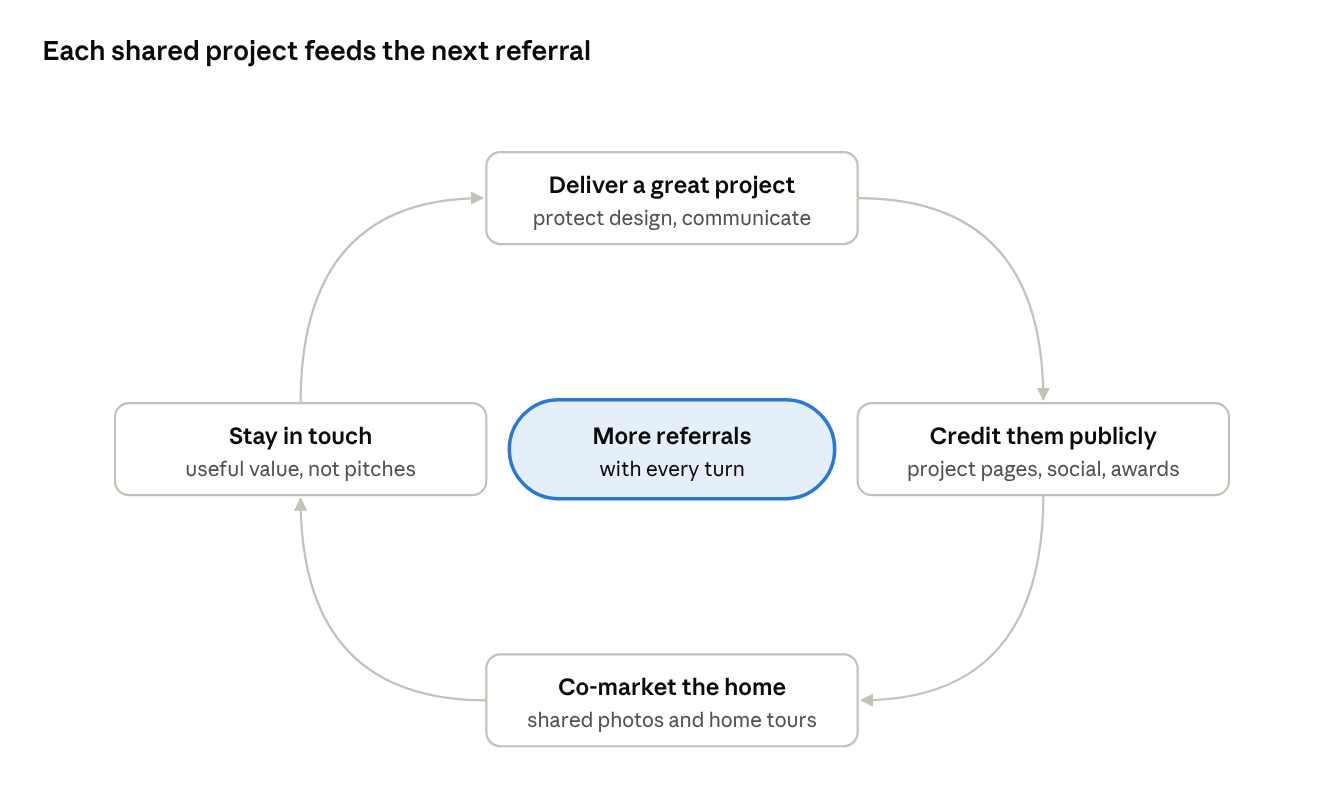
The steps below show how to build each part of this cycle into the way you work.
Step 1: Choose the Right Partners
Not every architect or designer is the right referral partner. Focus your effort where the fit is strongest.
- Start with people you’ve already worked with. A successful shared project is the best foundation for a partnership.
- Look for design professionals whose work matches yours. If you build $2 million to $5 million homes in a modern style, a firm known for that kind of work is a better match than one focused on small renovations.
- Consider interior designers and landscape architects too. They often work with the same high-end clients and may meet them at different stages.
- Think quality over quantity. A handful of strong relationships usually beats a long list of loose contacts.
Make a short list and treat each relationship as a long-term partnership, not a sales target.
Step 2: Lead With Value, Not a Sales Pitch
Architects get approached by builders, suppliers, and salespeople all the time. A builder who shows up with something useful stands out.
Ways to offer real value:
- Early budget input. Offer to review a design during development and give honest cost guidance. Helping an architect avoid a redesign after bids come back over budget is one of the most valuable things a builder can do.
- Constructability reviews. Spot details that will be difficult or expensive to build, and suggest alternatives that keep the design intent.
- Lot and site visits. Join early site visits to flag access, slope, utility, or foundation issues.
- Knowledge sharing. Offer short lunch sessions or job-site tours on topics they care about, such as new building methods, high-performance building envelopes, or material lead times.
The goal is to become the builder they call with questions. Referrals usually follow.
Step 3: Be Easy to Work With on Every Project
Nothing builds referrals like a project that goes well. Nothing kills them faster than one that doesn’t.
During shared projects:
- Agree on communication early. Set a regular update rhythm, such as weekly site meetings or written updates, and stick to it.
- Respect the design. Raise concerns and suggest alternatives through the architect, not around them.
- Handle changes and questions in writing. A clear process for questions and change orders protects everyone.
- Flag problems early. Bring cost or schedule issues to the architect quickly, with options.
- Keep the client experience smooth. A happy client makes the architect look good, which is exactly what makes them recommend you again.
After each project, ask the architect for honest feedback: what went well and what you could do better. It shows respect and helps you improve.
Step 4: Give Credit Publicly
Architects and designers build their businesses on their portfolios and reputation. When you give them credit, you give them something of real value.
- Name and link to them on your project pages. Include the architect, interior designer, and landscape architect, with links to their websites.
- Tag them when you share projects online. Every share puts their work in front of your audience.
- Credit them in awards entries and media features. Submit projects together where possible.
- Feature their words. A short quote from the architect on a project page adds credibility for you and visibility for them.
These credits also help your own marketing. When other architects see that respected firms choose to work with you, it builds trust before you ever meet. And when the architect links to the project on their own site, it can help your website’s authority too.
One caution: architects and designers make great testimonial partners for your website, but Google’s review policy doesn’t allow reviews based on professional or business relationships. Keep their endorsements on your site, proposals, and project pages rather than on your Google Business Profile.
Step 5: Co-Market Finished Homes
A finished home is a marketing asset for everyone who worked on it. Plan to share it from the start.
- Share professional photography. Agree before the shoot who pays and who can use the images, and for what. Splitting the cost of a professional shoot is common, and it gives both firms better images than either might pay for alone.
- Create a joint project story. Write a case study covering the design goals, the build challenges, and how the team solved them. Each partner can publish its own version and link to the other.
- Host home tours together, with the homeowner’s permission. Invite past clients, prospects, and other design professionals.
- Pitch local media together. Home and lifestyle publications like stories with a full team behind them.
We explain how to get months of marketing value from one finished home in How Market Leaders Maximize the Life of a Single Project.
Want marketing that architects are proud to share?
Talk to us. We will help you turn finished homes into project stories, credits and pages that make referring you easy.
Step 6: Stay in Touch Between Projects
Most referral relationships fade simply because the builder disappears between projects. Stay present without being pushy.
- Check in regularly, such as once a quarter, with something useful: a project update, a new material you’re excited about, or an invitation to see a home under construction.
- Invite them to site visits at interesting stages, such as framing or major structural work.
- Share their wins. Congratulate them on awards and published projects, and share their work with your audience.
- Remember the personal side. A thoughtful note at project completion or a simple thank-you goes a long way.
Step 7: Make Referring You Easy
The easier it is to refer to you, the more often it happens.
- Give them a simple handoff. A direct phone number or email for a named person, plus a short page they can send clients that explains how you work.
- Respond to referred clients fast, and tell the architect you’ve made contact.
- Keep them informed. Let them know how the conversation is going, within whatever the client is comfortable with.
- Protect their relationship with the client. If a referred client isn’t a fit, handle it respectfully, because how you treat their client reflects on them.
It helps to have a clear process for qualifying referred leads quickly and respectfully. Our guide on how to qualify custom home leads explains a simple approach.
Step 8: Thank Partners and Refer Work Back
Referral relationships last longest when they go both ways.
- Refer clients back. When a client comes to you without an architect or designer, recommend your partners.
- Say thank you every time. A personal call or note after each referral, whether or not it becomes a project.
- Be careful with paid referral fees. Some design professionals have professional rules or contract terms that limit them, and many prefer recognition and reciprocal referrals to payment. If you’re considering any financial arrangement, check the relevant rules and get proper advice first.
Make Your Website Architect-Friendly
Before an architect recommends you, they’ll look you up, and so will the client they refer. Your website should make that decision easy.
- Detailed project pages that show your quality and credit your design partners
- A clear process page explaining how you work with architects, from preconstruction through completion
- A short “For Architects and Designers” page that explains how you collaborate, what preconstruction services you offer, and who to contact
- Your team and credentials, so they know who they’ll work with. Your About page is a natural place for this.
- Reviews and testimonials from clients and partners
If your site doesn’t yet show your work at this level, our website design service for builders is built for exactly this audience. And because architects will also check your reviews and wider online presence, a steady reputation management process supports every referral.
Track Your Referrals
What gets measured gets managed. Add “referred by” to your inquiry form and CRM, and record it for every lead. Over time, you’ll see:
- Which partners send the most leads
- Which referrals turn into signed projects
- Which relationships need more attention
This also helps you thank the right people and invest your time where partnerships are strongest. Our reporting and analytics service can bring referral data together with your other lead sources in one view.
Common Mistakes That Stop Architect Referrals
- Pitching instead of helping. Leading with a sales message rather than useful value
- Going around the architect to the client on design decisions
- Surprise cost overruns with no early warning
- Not giving credit for the architect’s or designer’s work
- Disappearing between projects
- Mishandling a referred client who isn’t a fit
- Asking partners for Google reviews, which goes against Google’s review policy
Final Thoughts: Become the Builder Architects Trust
Architect and designer referrals aren’t luck. They’re the result of being the builder who protects the design, communicates well, gives credit generously, and stays in touch between projects.
Start with the partners you already know. Bring them value before you ask for anything. Make every shared project a showcase for both of you, and make referring to you simple. Over time, those relationships can become one of the most reliable sources of high-quality projects your business has.
If you’d like help building the marketing that supports these partnerships, from project storytelling to a website architects are proud to send clients to, talk to our team. Our lead generation service is designed around better-fit projects, not just more leads.
Become the Builder Architects Trust
We work only with custom home builders. Book a call and we will build the marketing that supports your design partnerships.
Frequently Asked Questions About Getting Referrals From Architects
Q1. How do custom home builders get referrals from architects?
By delivering shared projects well, protecting the architect’s design intent, communicating clearly, giving public credit, co-marketing finished homes, staying in touch with useful value, and making it easy to refer clients. Referrals usually follow trust built over real projects.
Q2. How do I approach an architect as a builder?
Lead with value rather than a pitch. Offer early budget input, a constructability review, or an invitation to see a project under construction. Choose firms whose work matches the homes you build, and focus on starting a long-term relationship.
Q3. What do architects want from a builder?
Most want a builder who respects and protects the design, communicates clearly and early, gives honest budget input, delivers high-quality work, runs organized jobsites, and keeps the client happy. Above all, they want a builder who makes them look good.
Q4. Should builders pay architects for referrals?
Be cautious. Some design professionals have professional rules or contract terms that limit referral payments, and many prefer recognition, credit, and reciprocal referrals. If you’re considering any financial arrangement, check the relevant rules and seek proper advice first.
Q5. Can architects leave Google reviews for my building company?
Google’s review policy doesn’t allow reviews based on conflicts of interest, including professional and contractual relationships. Ask architects for testimonials to feature on your website and in proposals instead.
Q6. How can my website help me get more architect referrals?
Architects and their clients will review your website before recommending or hiring you. Detailed project pages that credit design partners, a clear process page, and a page explaining how you work with architects all make the decision easier.
Q7. How long does it take to build referral relationships with architects?
It varies. Most strong partnerships develop over one or more shared projects. Starting with architects you’ve already worked with is usually the fastest path.