
LEAD QUALIFICATION
How to Qualify Custom Home Leads Before the First Meeting
Not every inquiry deserves a first meeting. Here are the questions to ask, a simple way to score leads, and how to say no without burning bridges.
ESTIMATED READ TIME: 14 MINUTES
Want to skip the reading? Speak directly with our Director of Growth Strategy.
Every custom home builder knows the feeling. You block out two hours for a first meeting, prepare a few project examples, maybe drive out to see a lot. Then, twenty minutes in, it becomes clear: the budget is half of what the home would cost, there’s no land, and “sometime in the next few years” is the timeline.
That meeting cost you time you could have spent on a real project, or with your family.
The answer isn’t to get fewer inquiries. It’s to learn more about each one before you commit your time. A good qualification process tells you, before the first meeting, whether a lead is ready, almost ready, or not a fit. It also makes serious buyers feel more confident in you, because it shows you run a professional business.
This guide lays out a practical system for qualifying custom home leads: what to ask, when to ask it, how to score the answers, and what to do with leads that aren’t ready yet.
The short answer: To qualify custom home leads before the first meeting, collect five key facts early: budget range, land status, timeline, financing, and design status (including whether they have an architect). Ask the basics on your website form, confirm them in a short discovery call, and score each lead as ready, nurture, or not a fit. Only ready leads get a full first meeting.
Why Lead Qualification Matters So Much for Custom Builders
A production builder might handle many sales conversations a week. A custom builder takes on far fewer projects each year, and each one involves a long relationship. That changes the math.
- Your time is the scarcest resource in the business. Every hour spent with a poor-fit lead is an hour not spent on design, estimating, site visits, or current clients.
- One wrong client can be very expensive. A client whose budget and expectations don’t match can lead to endless redesigns, disputes, and thin margins.
- Good buyers expect a process. Families planning a major custom build want to see that you’re organized. Thoughtful questions signal experience.
- Better data improves your marketing. When you know which leads were qualified, you can tell which channels are working. Without it, you’re guessing.
That last point is often overlooked. If you run ads or invest in SEO, qualification data tells you which sources bring real buyers, so you can spend more where it counts. We explain how leads typically reach builders in How Do Custom Home Builders Get Leads?
The Five Factors That Separate Real Buyers From Browsers
Every builder’s ideal client is a little different, but almost every qualification process comes back to five factors.
1. Budget
This is the most important factor and the most uncomfortable to ask about. Many builders avoid it until the second or third meeting, which is exactly how they end up wasting time.
You don’t need an exact number. You need to know whether the buyer’s expectations fit your typical project range. Asking for a range makes it easier for people to answer honestly.
How to ask: “Our homes typically range from $1.5 million to $4 million, depending on size and finishes. Which range are you planning for?”
Giving your own range first helps. It sets expectations and makes the question feel like useful information rather than a test. Make sure the range you share reflects your real recent projects, and say whether it includes land, design fees, and site work.
2. Land
A buyer who already owns a lot is much closer to building than one who hasn’t started looking. If they don’t own land yet, they may still be a good lead, just a later one.
What to learn:
- Do they own the land, have it under contract, or are they still searching?
- Where is it?
- Do they know anything about the lot, such as slope, utilities, or HOA rules?
The location also tells you whether the project is in your service area and whether the lot might bring site challenges that affect budget.
3. Timeline
When do they want to start building? “In the next six months” and “in a few years” are very different leads.
Timeline also hints at urgency. Buyers who are selling a current home, relocating for work, or have already bought land usually move faster.
4. Financing
You don’t need to see a bank statement, but you should know how the project will be paid for. Will it be paid in cash, with a construction loan, or through a combination? Have they spoken with a lender yet?
A buyer who has already talked to a lender about a construction loan usually has a clearer picture of their real budget.
5. Design Status
Where are they in the design process?
- No plans yet and looking for design-build?
- Working with an architect already?
- Have finished plans and want bids?
Each answer leads to a different conversation. If you offer design-build, early-stage buyers may be ideal. If they already have finished plans from an architect, the conversation may be about pricing and scheduling. Knowing this ahead of time helps you prepare.
Bonus: Fit and Expectations
Beyond the five factors, pay attention to softer signals:
- Who makes the decisions? Make sure all decision makers can attend the first meeting.
- What do they value? Quality, speed, energy efficiency, a specific style?
- How did they find you? Referrals and people who’ve studied your portfolio often fit better than people who clicked the first ad they saw.
- How do they communicate? Responsiveness and respect early on are often a preview of the whole project.
A Three-Stage System for Qualifying Leads
You don’t need to ask every question at once. The best process gathers information in stages, so serious buyers aren’t overwhelmed and you aren’t spending time too early.
Stage 1: Your website inquiry form
Your form is your first filter. It should be short enough that serious buyers complete it, but detailed enough to sort leads before anyone picks up the phone.
A strong builder inquiry form usually includes:
| Field | Format | Why it matters |
|---|---|---|
| Name, email, phone | Text fields | To follow up |
| Do you own land for this project? | Yes / Under contract / Still looking | Shows how close they are to building |
| Where is the property (or where are you looking)? | Text or dropdown of your service areas | Confirms it’s in your area |
| What is your target budget for construction? | Dropdown ranges that reflect your projects | Sorts budget fit early |
| When do you hope to start building? | Within 6 months / 6-12 months / 12+ months / Not sure | Shows urgency |
| Do you have plans or an architect? | No plans yet / Working with an architect / Have finished plans | Shows design stage |
| Tell us about your project | Open text box | Shows motivation and fit in their own words |
| How did you hear about us? | Dropdown | Shows which marketing works |
Some tips for the form:
- Use dropdowns for budget and timeline. People answer ranges more honestly and quickly than open boxes.
- Set the lowest budget option at your real minimum. If your projects start at $1.5 million, an option like “Under $1 million” lets buyers self-select out without awkwardness.
- Keep it to one page. Long multi-step forms can work, but every extra step loses some people.
- Make it easy on mobile. Many inquiries come from phones.
Will this reduce form submissions compared to a simple “name and email” form? Possibly. But the inquiries you get will be far more useful. For a custom builder, that’s a good trade. If your site isn’t getting inquiries at all, the form may not be the only issue, so see Why Isn’t My Home Builder Website Getting Leads?
Stage 2: A short discovery call
Before booking a full first meeting, schedule a 15- to 20-minute phone or video call. The goal is to confirm the form answers, fill in the gaps, and see whether there’s a good personal fit.
A simple discovery call outline:
- Thank them and set the agenda. “Thanks for reaching out. I’d love to learn about your project and share how we work, so we can see if a full meeting makes sense.”
- Ask about the project. “Tell me about the home you’re imagining. What’s driving the decision to build?”
- Confirm the land. “Tell me about the lot. Have you had any surveys, soil tests, or HOA reviews done?”
- Confirm budget, kindly. “You mentioned a budget of [range]. Does that include land and design, or construction only?”
- Confirm timeline and financing. “When would you ideally move in? Have you started talking to a lender about a construction loan?”
- Ask about decision makers. “Who else will be involved in decisions? Can they join our first meeting?”
- Explain your process briefly. Walk through what working with you looks like, from design through construction.
- Agree on next steps. If it’s a fit, book the first meeting. If not, say so kindly and point them toward a better option.
The discovery call is also where you share important expectations, such as your typical project range, your design or pre-construction fees, and how long your process usually takes. Buyers who aren’t a fit will often realize it themselves at this point.
Stage 3: Score the lead
After the form and the call, place each lead into one of three groups.
| Score | What it looks like | What to do |
|---|---|---|
| Ready | Budget fits, land owned or under contract, timeline within about 12 months, financing in progress | Book the full first meeting and prepare for it properly |
| Nurture | Good fit, but no land yet, or timeline beyond a year, or financing not started | Add to a follow-up sequence and check in at agreed times |
| Not a fit | Budget far below your range, outside your service area, or project type you don’t build | Decline politely and, where possible, refer them to someone better suited |
You can make this more detailed with a points system (for example, scoring each factor from 0 to 3), but most builders find three simple groups easier to use consistently. Consistency matters more than precision.
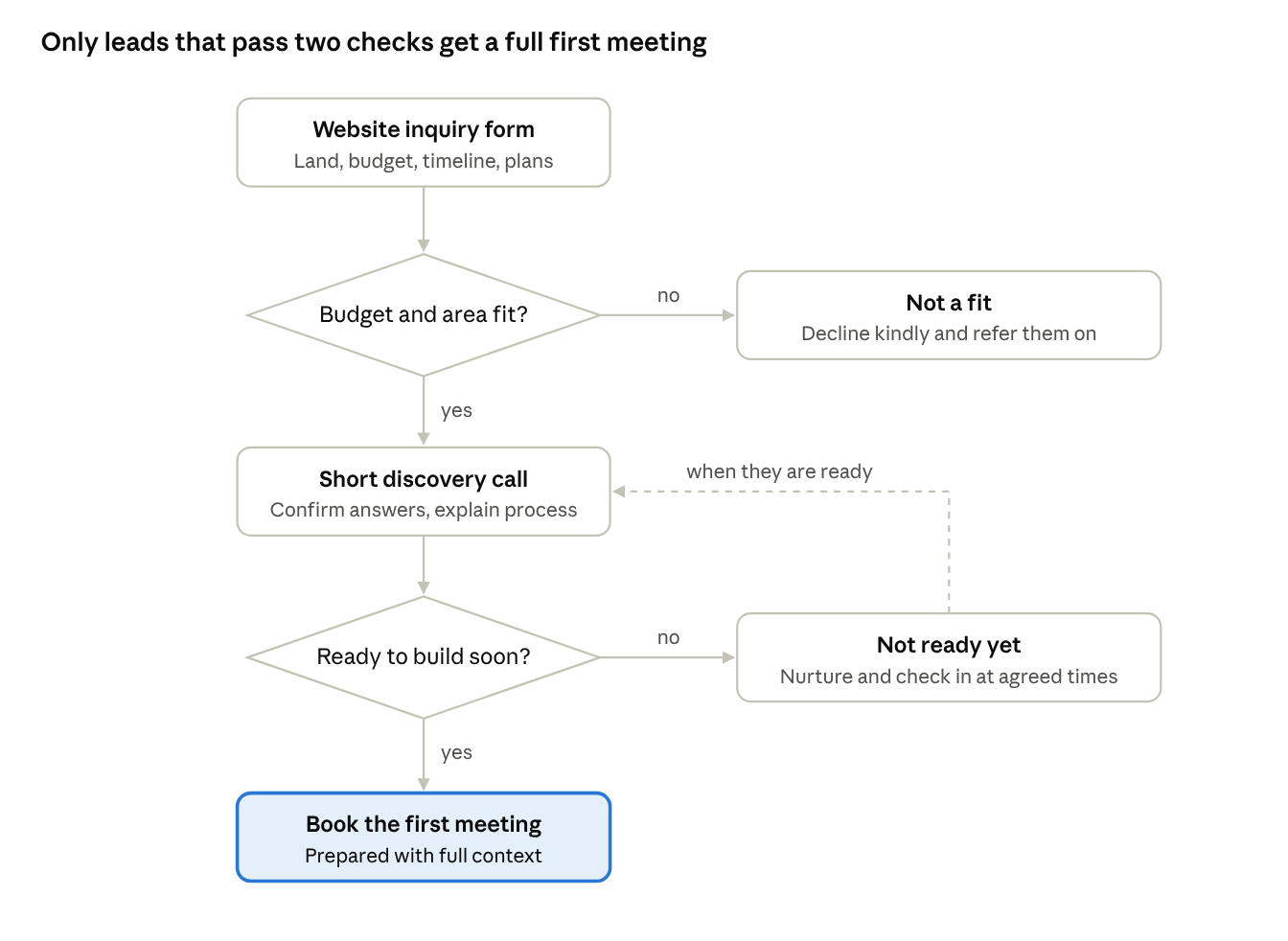
Nurture leads aren’t lost leads. Many of them become ready later, and the builder who stayed in touch is usually the one they call.
How to Handle Leads That Aren’t Ready Yet
Many good future clients are simply early. They’re still searching for land, saving, or waiting for a life event. Treating them as “bad leads” throws away future projects.
Instead, give them a simple nurture path:
- Agree on a check-in time. “It sounds like you’re about a year out. Would it be okay if I check in around next spring?”
- Send useful content, not sales messages. Lot-buying tips, what to expect during design, how custom home budgets work, recent project stories.
- Offer a low-commitment next step. For example, a lot review once they find land, or an invitation to a home tour.
- Track them in a CRM or simple spreadsheet with their timeline, so they don’t fall through the cracks.
Buyers who are early often talk to several builders and then forget most of them. The builder who stays helpful and present is the one they come back to.
How to Say No Without Burning Bridges
Saying no is part of running a healthy custom building business. The way you do it matters, because people talk.
A respectful decline might sound like this:
“Thank you so much for considering us. Based on what you’ve shared, I don’t think we’re the best fit for this project. Our homes typically start at a higher budget, and I wouldn’t want you to feel stretched. A builder who focuses on [project type] would likely serve you better, and I’m happy to suggest a couple of names.”
This approach protects your reputation, keeps the conversation positive, and often earns goodwill. That person may refer a friend who is a perfect fit.
Spending too many hours on the wrong leads?
Talk to us. We will help you set up an inquiry form and follow-up process that sorts serious buyers from browsers.
Speed Matters: Respond Before Someone Else Does
Qualification only works if you respond quickly. A serious buyer who reaches out to several builders will often move forward with the one who responds first and most professionally.
Practical ways to speed up response:
- Send an automatic confirmation right after a form submission, telling people what happens next and when.
- Set a target response time for your team, such as the same business day.
- Offer online booking for discovery calls so qualified leads can choose a time immediately.
- Route leads to one person who owns follow-up, so inquiries don’t sit in a shared inbox.
Prepare for the First Meeting Using What You Learned
The real payoff of qualification is a better first meeting. Because you already know the land, budget, timeline, and design stage, you can:
- Bring examples of past projects with a similar style, budget, or lot type
- Research the lot ahead of time, including zoning, slope, and access
- Prepare a clear explanation of your design and pre-construction process
- Come ready to discuss realistic budget ranges for what they’ve described
Buyers notice the difference. A builder who arrives prepared with relevant examples feels like a partner, not a salesperson.
Use Qualification Data to Improve Your Marketing
Every qualified lead tells you something about where your best clients come from. When you record the source of each lead along with its score, patterns appear quickly:
- Which channels produce “ready” leads, and which produce mostly “not a fit”
- Which towns or project types generate the strongest inquiries
- Which pages people visited before reaching out
This information helps you shift budget toward what works. It’s especially valuable for paid ads, where you can feed qualified-lead data back into the platform so it learns to find more buyers like your best ones. We cover that in Google Ads for Custom Home Builders.
If you want help building this system, from qualifying forms and automated follow-up to source tracking, our lead generation service and reporting and analytics service are designed for exactly this.
Common Lead Qualification Mistakes Builders Make
- Avoiding the budget question until the second or third meeting
- Using a contact form with only name and email, which gives you nothing to sort by
- Treating every lead the same, whether they’re ready next month or in three years
- Ghosting poor-fit leads instead of declining politely
- Not recording lead sources, so you never learn which marketing works
- Responding slowly, so serious buyers move on before you call
- Qualifying so aggressively that good buyers feel interrogated. Explain why you ask: so you can give them useful, honest guidance
Final Thoughts: Fewer Meetings, Better Projects
Qualifying leads isn’t about being exclusive. It’s about respecting your time and your prospective clients’ time. When you learn about budget, land, timeline, financing, and design stage before the first meeting, every meeting you take is one worth taking.
Start with a smarter website form. Add a short discovery call. Sort every lead into ready, nurture, or not a fit, and treat each group differently. Within a few months, you’ll notice fewer wasted evenings, better-prepared first meetings, and a pipeline you can actually plan around.
If you’d like help designing a qualification system that fits your business, talk to our team. We work only with custom home builders, and we know what a well-qualified pipeline looks like.
Fewer Meetings, Better Projects
We work only with custom home builders. Book a call and we will help you attract and qualify the leads that turn into signed projects.
Frequently Asked Questions About Qualifying Custom Home Leads
Q1. What questions should a custom home builder ask a new lead?
The most important questions cover five areas: budget range, land status, timeline, financing, and design status. For example: Do you own land? Where? What’s your target budget? When do you hope to start? Are you working with an architect? Have you spoken with a lender?
Q2. Should a builder ask about the budget on the website form?
Yes, using ranges rather than an open box. A budget dropdown that starts at your real minimum lets buyers self-select and saves both sides time. Most serious buyers appreciate the clarity.
Q3. How do you qualify a lead without sounding pushy?
Explain why you’re asking. For example: “We ask about budget and land early so we can give you honest guidance and show you relevant projects.” Share your own typical project range first, and keep the tone helpful rather than evaluative.
Q4. What should I do with leads who don’t own land yet?
If they’re otherwise a good fit, put them in a nurture group. Agree on when to check in, share helpful content about buying land, and offer to review a lot when they find one. Many become strong clients later.
Q5. How long should a discovery call be?
Around 15 to 20 minutes is usually enough to confirm the basics, answer initial questions, and decide whether a full first meeting makes sense. Save design discussions and detailed pricing for the first meeting.
Q6. Is it okay to turn away custom home leads?
Yes. Turning away poor-fit leads protects your time, your margins, and your reputation. Do it politely and, where possible, refer people to someone better suited. A kind “no” often leads to future referrals.
Q7. How does lead qualification help my marketing?
When you record where each lead came from and how it scored, you can see which channels bring real buyers. That lets you spend more on what works and less on what doesn’t, and it helps ad platforms learn which leads matter.