
LOCAL SEO
Local SEO for Custom Home Builders: How to Rank in the Towns You Build In
Buyers search for builders in the towns where they want to live. Here is how to show up in Google Maps and local results for every town you build in.
ESTIMATED READ TIME: 17 MINUTES
Want to skip the reading? Speak directly with our Director of Growth Strategy.
A family planning a $2 million home rarely starts with a referral alone anymore. Even when a friend gives them your name, they search for you. And when they don’t have a name yet, they type something like “custom home builder in Boulder” or “luxury home builder near me” into Google.
What shows up next decides who gets the first call. Usually it’s a map with three builders on it, followed by a list of websites. If you’re not in that map or near the top of that list, the family may never know you exist, however good your work is.
That’s what local SEO fixes. This guide explains, in plain terms, how Google decides which builders show up in local results and the exact steps a custom home builder can take to rank in the towns where they actually want to build.
The short answer: Local SEO for custom home builders means making your business easy for Google to match, trust, and show to people searching in your service area. Google says local results are based mainly on relevance, distance, and prominence. You improve them with a complete Google Business Profile, a website that proves where you build, a steady flow of genuine reviews, and mentions from other trusted local businesses.
What Local SEO Means for a Custom Home Builder
Local SEO is the part of search engine optimization that focuses on location-based searches. When someone searches for a service with a place in mind, Google shows results tied to that place.
For a custom home builder, those results usually appear in two places:
- The local map results (often called the “map pack”): A short list of businesses shown with a map, pulled from Google Business Profiles.
- The regular organic results: The website listings under the map, pulled from your website and its pages.
You want to appear in both. The map results win quick, high-intent clicks and calls. The organic results let you tell a fuller story with project galleries, process pages, and articles like this one.
Local SEO for a custom builder is also different from local SEO for a plumber or a roofer. A few reasons:
- Your buyers search less often but spend far more. You don’t need thousands of visitors. You need the right few dozen families and architects to find you.
- Your service area is selective. Most builders don’t want every job in a 100-mile radius. You want the towns, neighborhoods, and lot types that fit your best work.
- Trust matters more than speed. Nobody hires a builder for a multi-year project from one click. They check your reviews, your projects, and your reputation first. We cover that research journey in more detail in Digital Presence for Builders: Why Clients Research You First.
So the goal of local SEO for a builder is not just “rank higher.” It’s to rank in the right places, for the right searches, with enough proof that the right buyer picks up the phone.
How Google Decides Which Builders Rank Locally
Google has told business owners directly how local results work. According to Google’s own guide to improving local ranking, local results are based mainly on three things:
- Relevance: How well your business matches what someone searched for. Complete and detailed business information helps Google understand what you do.
- Distance: How far your business is from the location in the search, or from the searcher if no location is given.
- Prominence: How well known your business is. Google says this is based on information from across the web, including links, articles, and directories, and that more reviews and positive ratings can help.
Google also states clearly that there is no way to request or pay for a better local ranking. Ads can buy you a spot above the results, but the local rankings themselves are earned.
Here’s what this means in practice for a builder:
- You can control relevance completely. It comes from how well your profile and website describe what you build and where.
- You can’t move your office, so distance is mostly fixed. But you can show Google that you genuinely work in nearby towns, which helps you appear for searches that name those towns.
- Prominence is built over time. It comes from reviews, real-world reputation, and other websites talking about you. This is where established builders pull ahead, and where newer builders need a plan.
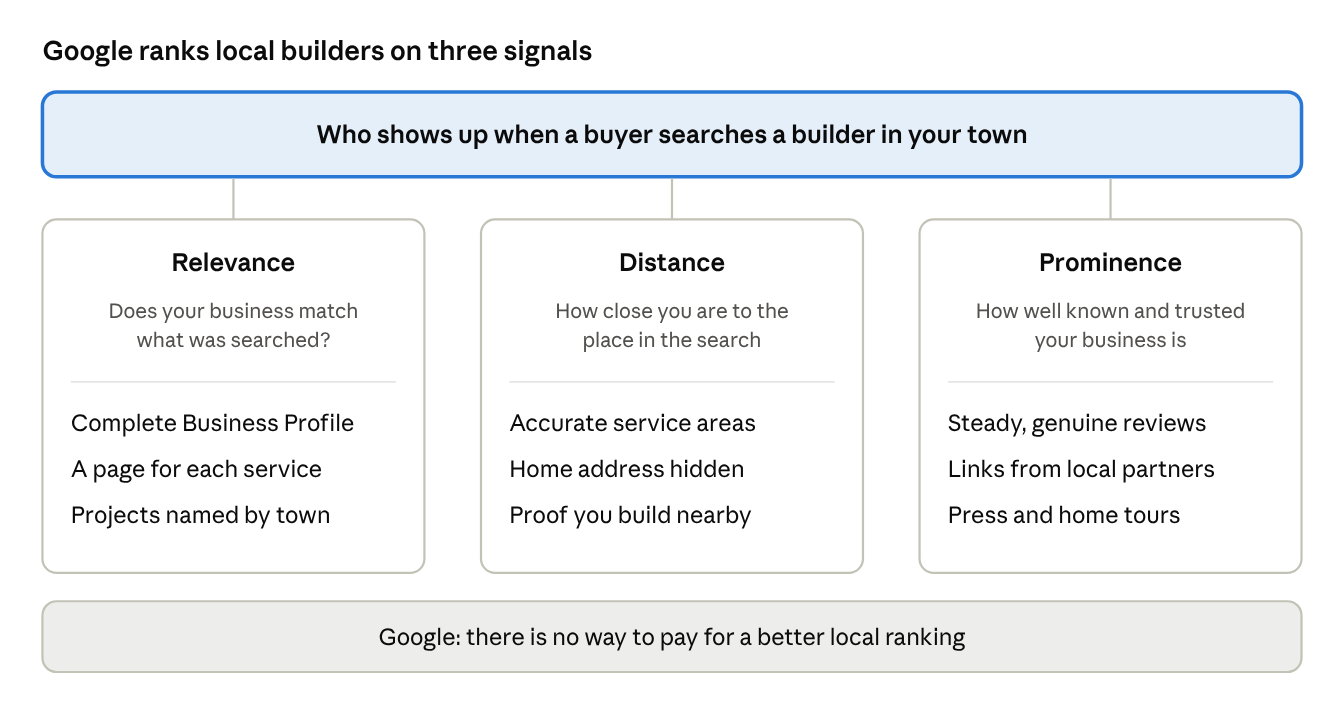
Image alt text: How Google ranks custom home builders in local search: relevance, distance and prominence
Every step in the rest of this guide strengthens at least one of these three signals.
Step 1: Set Up Your Google Business Profile Correctly
Your Google Business Profile is the listing that appears in the map results. For most builders, it’s the single biggest local SEO lever. It’s also where many builders make avoidable mistakes.
The most important thing to understand is that most custom home builders are service-area businesses. You go to your clients’ lots. Clients don’t usually walk into your office to buy a house. Google treats these businesses differently.
Here’s what Google’s rules say, and what they mean for you:
- Use one profile for your real, staffed office. Google’s guidelines for representing your business say service-area businesses should have one profile for their central office, with a service area set. A rented mailing address or a virtual office is not eligible.
- Hide your address if clients don’t visit it. If you work from home or don’t meet clients at your office, Google asks you to remove the address from your profile and show a service area instead.
- Set your service areas carefully. Google lets you add up to 20 service areas by city, postal code, or region. Google also says your overall area generally shouldn’t extend beyond about two hours of driving time from your base. Pick the towns where you actually build and want to build.
- Use your real business name. Don’t add keywords like “Best Luxury Custom Homes Denver” to your name. Google’s guidelines say your name should match how your business appears in the real world. Keyword-stuffed names risk suspension.
- Choose the most specific primary category. Google asks for the fewest categories that describe what your business is. For most builders, the right primary category is “Custom home builder” or “Home builder.” Add secondary categories only if they truly describe your business, such as “General contractor” if you also take on major renovations.
- Fill in every field you can. Add your services, a clear description, your website, your phone number, and your hours. Google’s local ranking guide says complete, accurate information helps you match more searches.
- Add real project photos and keep adding them. Google lists photos as one of its tips for improving your profile. Upload finished homes, interiors, and work in progress. Avoid stock images.
Getting the profile set up is only the start. Keeping it active with fresh photos, updates, and review replies is what keeps it competitive.
Step 2: Build a Website That Proves Where You Build
Your Business Profile drives the map results. Your website drives the organic results below them. It also gives Google the detail it needs to connect your business with specific towns.
A strong local website for a custom builder usually includes:
- A clear homepage that names your region. Say what you build and where, in plain words, near the top. For example: “Custom homes on hillside and mountain lots across Boulder County.”
- A page for each core service. Custom homes, design-build, and major renovations each deserve their own page if you offer them. One vague “services” page makes it harder to rank for any of them.
- Detailed project pages. Each finished home is proof that you build in a specific place. A project page should name the town or neighborhood, the style of home, the size, the challenges you solved, and what the client said. More on this in Step 3.
- Service-area or location pages, used carefully. A page for a key town can help, but only if it has genuinely useful local content. Google’s spam policies warn against doorway pages, such as many near-identical pages that only swap the city name. One strong page per key market beats twenty thin ones.
- Your name, address, and phone number (NAP) in the footer. Keep it identical to your Business Profile. If your address is hidden on Google, you can still show your city and phone number.
- Local business structured data. Structured data is code that helps Google read key facts about your business. Google’s LocalBusiness structured data documentation explains how to add your name, address, phone, and opening hours, and recommends using the most specific business type that fits.
- Fast, mobile-friendly pages. Many buyers will first see your site on a phone. Slow galleries and pop-ups cost you visitors before they see your work.
If your current site is missing several of these, it’s worth fixing before you invest heavily in other local SEO work. Our custom home builder website checklist covers the full list. Our team builds websites for custom home builders with this structure in place from day one.
Step 3: Turn Every Finished Project Into Local Proof
This is the step most builders skip, and it’s one of the most powerful.
Every home you finish is a piece of local evidence. It shows Google, and buyers, that you build in a specific town, on a specific type of lot, in a specific style. A gallery of unlabeled photos wastes that evidence.
Turn each finished home into a full project page:
- Name the location. Use the town or neighborhood (with the client’s permission) in the page title and opening paragraph. For example: “Modern Mountain Home in Evergreen, Colorado.”
- Tell the story. What did the client want? What made the site difficult? How did you solve it? This is the kind of first-hand detail that only you can write, and it’s exactly what Google means by helpful, experience-based content.
- Describe the home in searchable terms. Mention the style, size, and key features in natural sentences, such as “a 5,200-square-foot modern farmhouse with a walkout basement.”
- Write descriptive image file names and alt text. “evergreen-modern-mountain-home-kitchen.jpg” tells Google far more than “IMG_4471.jpg.”
- Add a client quote or review. Real words from the homeowner add trust for buyers and for Google.
- Link to the project from related pages. Link from your service page and any relevant location page so Google can find it easily.
One finished project can also feed months of other marketing. We explain how in How Market Leaders Maximize the Life of a Single Project.
Step 4: Earn Reviews That Mention the Work
Reviews are one of the few local ranking signals Google names directly. Its local ranking guide says more reviews and positive ratings can help your local ranking, and that replying to reviews shows you value your customers.
For a custom builder, reviews also do something more important: they reassure a family that is about to trust you with a very large investment.
A few practical rules:
- Ask at the right moments. The best times are usually at key milestones, such as move-in day or the end of the first season in the home, when the client is happiest.
- Make it easy. Send a direct link to your review form by text or email. Most people won’t hunt for it.
- Encourage detail, not scripts. Ask clients to mention what you built and where, if they’re comfortable. A review that says “They built our home in Castle Rock on a tough sloped lot” is more useful to buyers than “Great job!” Never write reviews for clients or offer payment for them, which breaks Google’s review content policy.
- Ask architects for testimonials, not Google reviews. Architects and designers can speak to your process, but Google’s policy doesn’t allow reviews based on professional relationships. Feature their words on your website instead.
- Reply to every review. Thank happy clients by name and project. Respond to criticism calmly and professionally. Future buyers read your replies as closely as the reviews.
If reviews are a weak spot for your business, our reputation management service builds a steady, compliant review process into your client journey. For scripts and timing ideas, see how custom home builders get more Google reviews.
Step 5: Get Mentioned by Trusted Local Businesses
Prominence isn’t only about reviews. Google’s local ranking guide says it also draws on information from across the web, such as links, articles, and directories. In simple terms: when other respected local websites mention and link to you, Google gains confidence that you’re a real, established builder.
The good news is that custom builders already have natural relationships that can produce these mentions:
- Architects and interior designers you’ve worked with can feature shared projects on their sites and credit you as the builder.
- Suppliers and showrooms (cabinetry, windows, stone, lighting) often showcase homes their products went into.
- Local home tours and design events usually list participating builders on their websites.
- Local and regional media, such as home and lifestyle magazines or community news sites, cover notable homes and local business stories.
- Community involvement, such as sponsoring a local charity build or school event, often comes with a mention on the organizer’s site.
- Industry and trade associations in your region typically list members in an online directory.
The key is that these links should come from real relationships. Buying links or joining link schemes is against Google’s spam policies and can hurt you. The best local links are the ones a buyer might actually click.
Want to rank in the towns you actually build in?
Talk to us. We will review your Google Business Profile, project pages and reviews, and show you what is holding your local rankings back.
Step 6: Keep Your Business Details Consistent Everywhere
Your business name, address, phone number, and website appear in many places: your Business Profile, your website, social profiles, directories, and association listings.
When these details don’t match, it creates doubt. A buyer might call an old number. Google may be less sure which details are correct.
Do a simple audit once a year:
- Search your business name and note every listing that appears on the first few pages.
- Check that your name, phone number, website, and (if shown) address match your Business Profile exactly.
- Update or remove old listings, especially after a move, rebrand, or phone change.
- Keep the same format everywhere. “Suite 200” and “Ste. 200” are minor, but a different phone number is not.
This isn’t glamorous work, but it removes friction for both Google and your future clients.
Step 7: Make Your Site Easy for Google and AI Search to Understand
More and more buyers now see AI-generated summaries at the top of Google, or ask AI assistants which builders to consider. Many builders wonder if they need a separate strategy for this.
Google’s guidance on AI features and your website is clear: there are no extra requirements or special tricks to appear in AI Overviews or AI Mode. The same SEO fundamentals apply. Google specifically recommends:
- Making sure your pages can be crawled and indexed.
- Using internal links so your content is easy to find.
- Keeping important information in text, not only inside images or videos.
- Making sure any structured data matches what’s visible on the page.
- Keeping your Business Profile information up to date.
For builders, this means a few practical things. Write your services, service areas, and process in plain text on your site, not just in image captions. Answer the questions buyers actually ask, like how long a custom home takes or how your pricing works. And use clear headings, so both people and machines can find the answer quickly.
Finally, set up Google Search Console, Google’s free tool for checking how your site appears in search. It shows which searches bring people to your site and flags technical problems.
How to Measure Your Local SEO Results
Local SEO is a long-term investment, so you need a way to tell whether it’s working. Focus on numbers that connect to real projects, not vanity metrics.
| What to track | Where to find it | Why it matters |
|---|---|---|
| Calls, website clicks, and direction requests from your profile | Business Profile performance report (Google’s guide) | Shows whether map results are producing real actions |
| Searches that include your town names | Google Search Console, Performance report | Shows whether you’re being found for the areas you target |
| Rankings for key local searches | Manual checks or a rank-tracking tool | Shows progress for your most important searches |
| Number and quality of new reviews | Your Business Profile | Tracks one of Google’s named ranking signals |
| Qualified leads by source | Your CRM, call tracking, or lead log | The number that actually matters: inquiries from fit buyers |
The last row is the one to watch most closely. A builder doesn’t need more traffic. A builder needs more conversations with the right families. If you’re not sure where your leads currently come from, our reporting and analytics service sets up tracking that ties every inquiry back to its source.
Common Local SEO Mistakes Custom Home Builders Make
These are the problems we see most often when we review a builder’s local presence:
- Stuffing keywords into the business name. It might seem to help for a while, but it breaks Google’s guidelines and puts your profile at risk.
- Using a virtual office or mailbox to appear in a new town. Google doesn’t allow it, and suspended profiles are hard to recover.
- Creating copy-paste town pages. Twenty pages that only swap the city name look like doorway pages. They rarely rank and can drag down trust in your whole site.
- Leaving project photos unlabeled. A beautiful gallery with no locations, stories, or descriptive file names gives Google almost nothing to work with.
- Asking for reviews only once in a while. A burst of reviews followed by a long silence looks less natural than a steady flow.
- Ignoring reviews. Unanswered reviews, especially negative ones, send a poor signal to the very buyers you want.
- Targeting broad terms instead of fit-based ones. Ranking for “home builder” in a large metro might bring tract-home shoppers. Searches like “custom home builder in [town]” or “luxury mountain home builder” bring buyers who fit your work.
- Expecting results in weeks. Local SEO compounds over months. The builders who win are the ones who keep going.
Final Thoughts: Rank Where You Want to Build
Local SEO isn’t about tricking Google into showing your business. It’s about making it obvious, to Google and to buyers, that you are a trusted builder in the towns you serve.
Start with the foundation: a correct Google Business Profile and a website that clearly shows where and what you build. Then add the proof that compounds over time: detailed project pages, steady reviews, and real mentions from the architects, suppliers, and local organizations you already work with.
Do that consistently, and the builder that shows up first when a qualified family searches your town is far more likely to be you.
If you’d like a clear picture of where your local visibility stands today, talk to our team. We work only with custom home builders, and our SEO service is built around getting you found by the buyers who fit your work.
Rank Where You Want to Build
We work only with custom home builders. Book a call and we will map out the local SEO work that puts you in front of buyers in your towns.
Frequently Asked Questions About Local SEO for Home Builders
Q1. What is local SEO for custom home builders?
Local SEO for custom home builders is the process of improving how your business appears in location-based Google searches, such as “custom home builder in Aspen.” It covers your Google Business Profile, your website’s local content, your reviews, and mentions of your business on other local websites.
Q2. How do custom home builders show up in Google Maps?
To show up in Google Maps, a builder needs a verified Google Business Profile with accurate information, the right primary category, a realistic service area, and regular activity such as photos and review replies. Google ranks map results based on relevance, distance, and prominence.
Q3. Can I rank in a town where I don’t have an office?
Yes, but not by creating a fake address. Google doesn’t allow virtual offices or mailboxes. Instead, add the town to your Business Profile service areas, publish project pages for homes you’ve built there, and earn reviews and mentions that connect your business to that area. Ranking in the map results is harder far from your office, but organic results can still work well.
Q4. Do reviews really affect local rankings for builders?
Yes. Google’s own local ranking guide says more reviews and positive ratings can help a business’s local ranking. For custom builders, reviews matter even more because buyers rely on them before trusting a builder with a major investment.
Q5. Should I create a separate page for every town I serve?
Only for towns where you have something genuinely useful to say, such as completed projects, local building considerations, or neighborhoods you specialize in. Google’s spam policies warn against near-identical city pages built just to rank. A few strong pages beat many thin ones.
Q6. How long does local SEO take for a home builder?
Most builders see early improvements, such as more profile views and calls, within a few months of fixing their profile and website. Stronger rankings in competitive markets usually take longer, because prominence (reviews, links, reputation) builds over time. We explain realistic timelines in how long SEO takes for a construction company.
Q7. Is local SEO different from AI search optimization?
Not as much as many people think. Google says there are no special requirements to appear in AI Overviews or AI Mode beyond standard SEO best practices. Clear, helpful content, a well-structured site, and accurate business information help you in both.