
SEO KEYWORDS
SEO Keywords for Custom Home Builders: Which to Target and Which to Ignore
The right keywords bring serious buyers. The wrong ones bring traffic that never calls. Here is which search terms to target, which to ignore, and how to map them to your pages.
ESTIMATED READ TIME: 14 MINUTES
Want to skip the reading? Speak directly with our Director of Growth Strategy.
Most builders who start with SEO make the same move. They open a keyword tool, type in “home builder,” and go after the term with the biggest number next to it.
It feels logical. More searches should mean more leads. But for a custom home builder, the biggest keywords are often the worst ones. They attract people shopping for tract homes, house plans, starter homes, or builder jobs. You can rank for them and still not get a single call from a buyer who fits your work.
The builders who win with SEO choose keywords differently. They look for searches that reveal a serious buyer: someone who wants a custom home, in a specific place, at a level of quality that matches what they build. Those searches are smaller. They’re also far more valuable.
This guide shows you which SEO keywords custom home builders should target, which ones to ignore, how to find the right ones for your market, and how to use them on your website.
The short answer: Custom home builders should target keywords that combine buyer intent with fit: a builder type plus a location (“custom home builder Boulder”), price or style terms (“luxury mountain home builder”), process terms (“build on your lot,” “design-build”), and the detailed questions buyers ask before choosing a builder. Ignore broad, low-fit terms like “home builders,” “cheap houses,” “house plans,” and anything related to jobs or DIY.
Why Keyword Choice Matters More for Custom Builders
Keyword strategy for a custom builder is different from keyword strategy for most businesses.
- Your buyers are few, but each one is worth a lot. You don’t need thousands of visitors. You need the right few families and architects to find you.
- Fit matters as much as intent. A person searching “home builders near me” may be ready to buy, but ready to buy a production home that you don’t build.
- Many valuable searches look small in keyword tools. Searches like “custom home builder Evergreen CO” may show very low or no volume, yet a single click from that search could become a multi-million-dollar project.
- The buying journey is long. Buyers research for months, often starting with questions about cost, land, and process before they look for a builder. Keywords at each stage matter.
The goal of keyword research for a builder isn’t to find the most traffic. It’s to find the searches that lead to the most qualified conversations.
Understanding Search Intent: The Four Types of Keywords
Every search has a purpose behind it. Understanding that purpose, known as search intent, helps you decide which keywords to target and what kind of page to build for each one.
| Intent type | What the searcher wants | Builder examples | Best page type |
|---|---|---|---|
| Local and transactional | To find and contact a builder now | custom home builder Scottsdale, luxury home builders near me | Homepage, service pages, location pages |
| Commercial investigation | To compare options and approaches | design build vs general contractor, custom vs semi-custom home | Comparison articles, process pages |
| Informational | To learn and plan | how much does it cost to build a custom home in Colorado, how long does it take to build a custom home | Blog posts, guides |
| Brand | To check you out | [your company] reviews, [your company] homes | Homepage, reviews page, project pages |
A strong keyword plan covers all four. Local and transactional keywords bring ready buyers. Informational and comparison keywords reach buyers earlier and build trust long before they’re ready to call. Brand searches show that your reputation is growing.
SEO Keywords Custom Home Builders Should Target
These are the keyword groups that tend to bring the best-fit buyers. Replace the example towns and styles with your own.
1. Builder type + location
These are your most important keywords. They show clear intent and a specific place.
- custom home builder [town]
- custom home builders in [county or region]
- custom home builders near me
- home builder [neighborhood or community name]
- [town] custom homes
Don’t stop at your main city. Buyers often search by the exact town, neighborhood, mountain community, or lake area where they own land. If you build in those places, they belong on your list. For “near me” searches, your Google Business Profile matters as much as your website, as we explain in our guide to local SEO for custom home builders.
2. Luxury and price-tier keywords
These help filter for budget.
- luxury home builder [town]
- luxury custom homes [region]
- high-end home builder [town]
- estate home builder [region]
Use these only if they genuinely describe your work. Ranking for “luxury” terms and then disappointing visitors with your portfolio wastes the click.
3. Style and home-type keywords
Buyers who search by style often have a clear vision and budget. These keywords also help you stand out where many builders compete for the same generic terms.
- modern custom home builder [region]
- mountain home builder [region]
- modern farmhouse builder [town]
- timber frame home builder [region]
- lake home builder [lake or area name]
- energy-efficient custom homes [region]
Pick the styles you actually build and want more of. Your project gallery should back them up.
4. Process and service keywords
These describe how you work and often signal buyers who are further along.
- design build firm [town]
- build on your lot [region]
- builders who build on your land [town]
- knockdown rebuild [town], or teardown and rebuild
- custom home builder with architect, or architect-led builds
If you offer design-build or build-on-your-lot programs, these keywords deserve their own pages.
5. Land and site keywords
Many custom builds start with a challenging lot. Buyers search for help with exactly that.
- hillside home builder [region]
- building on a sloped lot [region]
- building a home on acreage [region]
- how to evaluate a lot for a custom home
These keywords are especially valuable in mountain, lake, and rural markets.
6. Question keywords for blog content
Before buyers look for a builder, they research. They ask questions about cost, timeline, process, and risks. Answering these well brings buyers to your site early and builds trust. It’s also the type of content that tends to appear in AI-generated answers.
- how much does it cost to build a custom home in [state or region]
- how long does it take to build a custom home
- custom home vs semi-custom home
- design-build vs hiring an architect and builder separately
- what to ask a custom home builder before hiring
- how to finance a custom home build
- cost to build on a sloped lot
You can find more of these by typing a topic into Google and looking at the autocomplete suggestions, the “People also ask” box, and the related searches at the bottom of the page.
7. Brand keywords
People who hear your name search for it, often with words like “reviews,” “homes,” or “cost.” Make sure your homepage, reviews page, and Google Business Profile show up strongly for your name. Monitor these searches over time. Growth in brand searches is a good sign your reputation is spreading.
Keywords Custom Home Builders Should Ignore (or Handle With Care)
Some keywords look attractive because of their volume but rarely bring buyers who fit a custom builder.
| Keyword | Why it’s a problem | What to do instead |
|---|---|---|
| home builders, new homes | Mostly production and tract-home shoppers | Add “custom,” a location, or a style |
| new homes for sale [town] | Buyers want finished inventory, not a build | Ignore unless you sell spec homes |
| cheap, affordable, low-cost homes | Budget doesn’t match custom building | Ignore |
| house plans, floor plans free | Often DIY or plan shoppers | Only target if you sell plans or offer design-build with a plan library |
| modular, prefab, kit homes | Different product entirely | Ignore unless you build these |
| home builder jobs, construction careers | Job seekers, not buyers | Ignore (use a careers page if hiring) |
| how to build a house yourself | DIY audience | Ignore |
| remodeling, repair, handyman | Smaller projects | Target only if you offer major renovations |
A good rule: if a keyword is more likely to attract someone you’d decline, it’s not worth targeting, however large its search volume.
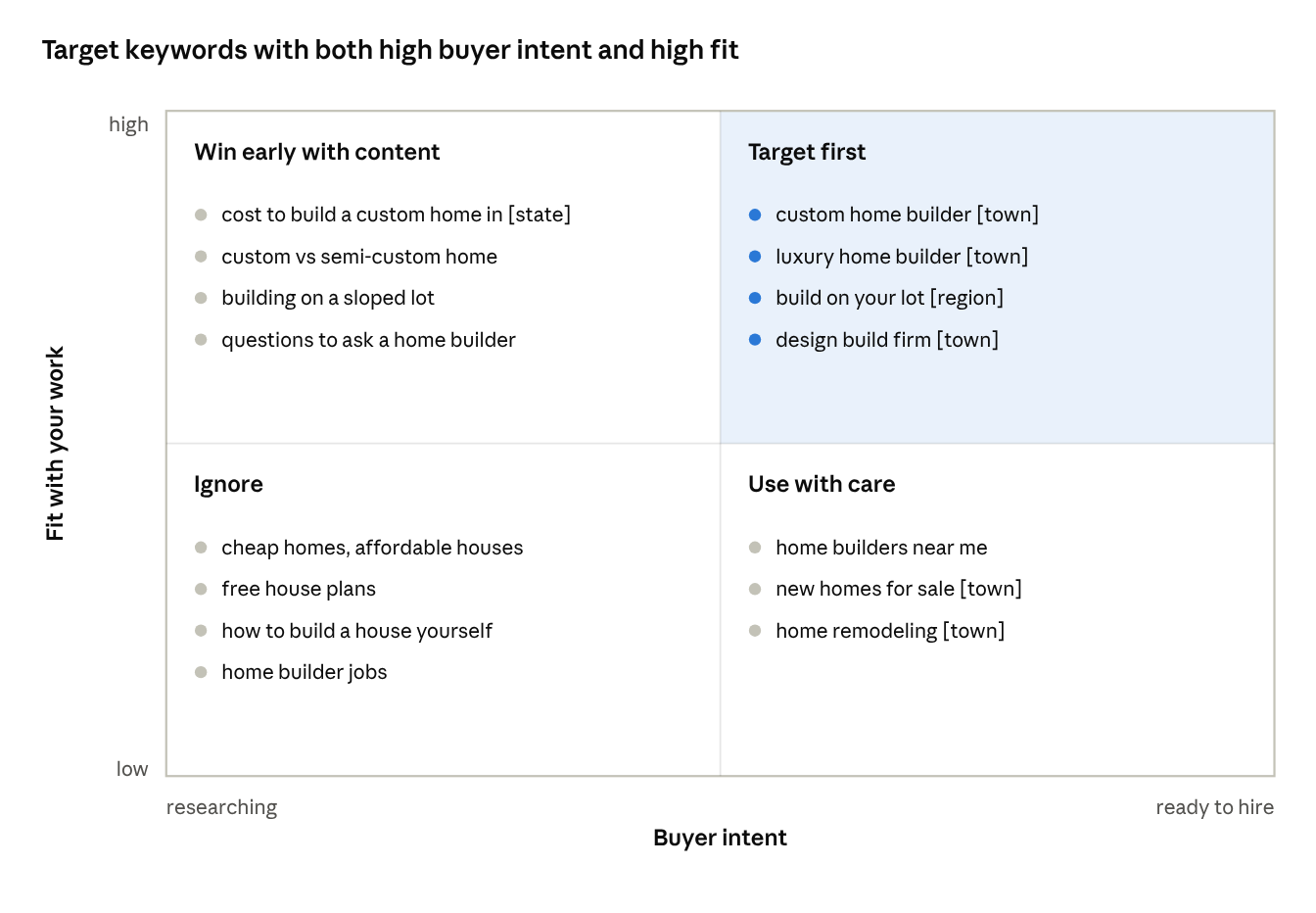
Put most of your effort into the top half of this matrix. High-fit keywords bring buyers who match your work, whether they’re ready to hire now or still researching.
How to Find the Right Keywords for Your Market
The best keyword research for a builder mixes tools with real-world knowledge of your buyers. Here’s where to look.
- Your clients’ own words. Review inquiry forms, emails, and notes from first meetings. How do buyers describe what they want? “Mountain modern,” “build on our land,” “lake house”? Those phrases are often exactly what they typed into Google.
- Your sales conversations. List the questions you answer again and again, such as cost per square foot, timelines, lot evaluation, and design fees. Each one is a potential article.
- Google Search Console. If your site is live, the Performance report shows the real searches that already bring people to your site, along with clicks, impressions, and average position. It’s the most reliable keyword data you have, because it’s about your site specifically.
- Google’s Keyword Planner. Keyword Planner suggests related keywords and estimates monthly search volume. It requires a Google Ads account. Use it for ideas and rough comparisons, not as the final word.
- Google search itself. Type your main keywords into Google and study the autocomplete suggestions, the “People also ask” questions, and the related searches. Also note what kind of pages rank: service pages, directories, or articles. That tells you what Google thinks the searcher wants.
- Google Trends. Google Trends shows how interest in a search changes over time and across regions, which can reveal seasonal patterns or rising styles.
- Your Google Business Profile. Your profile’s performance report shows some of the searches people used to find your listing.
Don’t Dismiss Low-Volume Keywords
Keyword tools often show very low numbers, or none at all, for specific local searches like “custom home builder [small mountain town].” Many builders skip these. That’s a mistake.
Remember three things:
- Search volume estimates are rough, especially for small towns and niche terms.
- Many related searches add up. One page about building in a specific area can rank for dozens of variations.
- Value matters more than volume. For a custom builder, a keyword that brings one serious buyer a year can be worth more than a keyword that brings thousands of visitors who will never build.
If a keyword clearly describes a buyer you want, it’s usually worth targeting, whatever the tool says.
How to Map Keywords to Pages
Once you have a keyword list, assign each important keyword to one specific page. This is called keyword mapping. It keeps your site organized and avoids two of your own pages competing for the same search.
| Page type | Example primary keyword | Supporting keywords |
|---|---|---|
| Homepage | custom home builder [main region] | luxury home builder [region], [your company] |
| Service page: custom homes | custom home builder [main town] | custom homes [town], build a custom home [region] |
| Service page: design-build | design build firm [town] | design build custom homes, design and build [region] |
| Service page: build on your lot | build on your lot [region] | builders who build on your land [town] |
| Location page | custom home builder [secondary town] | luxury homes [town], [town] home builder |
| Project page | [style] home in [town] | [town] custom home, [style] custom home |
| Blog post | how much does it cost to build a custom home in [state] | cost per square foot custom home [state] |
A few rules:
- One primary keyword per page. Supporting keywords should be close variations or related ideas.
- Match the page type to the intent. A “how much does it cost” search wants an article with real answers, not a sales page.
- Link related pages together. Blog posts should link to the matching service page, and service pages should link to relevant projects.
Location pages need special care to avoid thin, repetitive content. We cover that in Should Custom Home Builders Create Location Pages for Every Town They Serve?
Not sure which keywords are worth chasing?
Talk to us. We will research the searches buyers use in your market and match them to the right pages.
How to Use Keywords on Your Pages
Choosing keywords is half the work. Using them well is the other half. Place your primary keyword naturally in:
- The page title (the clickable headline in search results)
- The main heading (H1) on the page
- The URL, kept short and readable, such as /custom-home-builder-boulder/
- The first paragraph, so readers and Google know right away what the page is about
- A few subheadings, where it reads naturally
- Image file names and alt text, such as “modern-mountain-home-boulder-exterior.jpg”
- Internal links from other pages, using descriptive link text
Then stop. Google’s spam policies describe keyword stuffing, such as repeating keywords unnaturally or adding blocks of city names, as a way of trying to manipulate rankings. It also makes your site read poorly to buyers.
Google’s guidance on creating helpful, people-first content is a better guide than any keyword density rule. Google says it doesn’t prefer a particular word count, and it rewards content that shows first-hand experience and leaves readers feeling they’ve learned what they needed. For a builder, that means real project details, real prices or ranges where you can share them, and honest answers to hard questions.
Keywords and AI Search
Buyers increasingly ask full questions, both in Google and in AI assistants. Instead of “custom home builder cost,” they might ask, “How much does it cost to build a 4,000-square-foot custom home on a sloped lot near Boulder?”
This makes question-based content even more important. Google has said there are no special requirements to appear in its AI features beyond standard SEO best practices. In practice, that means:
- Answer common questions directly and clearly, near the top of a section
- Use headings that match the way people ask questions
- Include specific details that only an experienced builder would know
- Keep your business information consistent across your website and Business Profile
The FAQ sections at the end of articles like this one are a simple way to capture these question-style searches.
How to Measure Whether Your Keywords Are Working
Track progress every month:
- Rankings for your mapped keywords, especially builder + location terms
- Impressions and clicks in Search Console for the queries you target
- Organic inquiries, and which pages people visited before reaching out
- Lead quality from organic search, using a simple ready / nurture / not-a-fit score
If a page ranks but brings poor-fit inquiries, the keyword may be wrong, even if the traffic looks good. Adjust the target or the page content. SEO for builders takes time, so judge keyword performance over months, not weeks. We explain realistic timelines in How Long Does SEO Take for a Construction Company?
Common Keyword Mistakes Builders Make
- Chasing the biggest search volumes instead of the best-fit searches
- Targeting only one city when buyers search by town, neighborhood, and community
- Using “luxury” keywords without a portfolio that supports them
- Targeting the same keyword on several pages, so they compete with each other
- Writing for keywords instead of buyers, which leads to stiff, repetitive pages
- Ignoring question keywords, which reach buyers early and build trust
- Never checking Search Console, the best free source of real keyword data for your site
Final Thoughts: Choose Keywords That Bring the Right Buyers
The right keywords for a custom home builder aren’t the biggest ones. They’re the ones that describe the exact buyers you want: people looking for a custom home, in your towns, in your style, at your level of quality.
Target builder-plus-location searches first. Add luxury, style, process, and land keywords that match your real work. Answer the questions buyers ask early in their journey. Map every keyword to one page, use it naturally, and measure success by qualified inquiries, not traffic alone.
If you’d like a keyword plan built around your market and your ideal projects, our SEO service for custom home builders starts there. Book a strategy call and we’ll show you which searches your best future clients are using today.
Choose Keywords That Bring the Right Buyers
We work only with custom home builders. Book a call and we will build a keyword plan around the buyers you want.
Frequently Asked Questions About SEO Keywords for Home Builders
Q1. What are the best SEO keywords for custom home builders?
The best keywords combine a builder type with a location or style, such as “custom home builder [town],” “luxury home builder [region],” or “modern mountain home builder.” Process keywords like “build on your lot” and “design build firm [town]” also tend to bring serious, well-fitting buyers.
Q2. Should home builders target “home builders near me”?
It can bring traffic, but it often attracts people looking for production or tract homes. Custom builders usually get better results by targeting “custom home builders near me” and specific location searches, while making sure their Google Business Profile is strong for nearby searches.
Q3. How many keywords should a home builder target?
There’s no set number. Start with one primary keyword per important page, such as your homepage, each service page, key location pages, and each blog post. A small site might focus on 20 to 40 primary keywords, with many related variations supporting them.
Q4. Are low-volume keywords worth targeting for builders?
Yes, if they describe a buyer you want. Search volume estimates for local and niche terms are often low or missing, but a single project from one of these searches can be worth far more than thousands of visits from broad terms.
Q5. How do I find what buyers are searching for in my area?
Combine your clients’ own words with Google Search Console, Google’s Keyword Planner, Google Trends, and Google’s autocomplete and “People also ask” suggestions. Your past inquiries and sales conversations are often the best source of high-value keyword ideas.
Q6. How often should I review my keywords?
Review your keyword performance monthly and your overall keyword plan every six to twelve months, or whenever you add a new service, enter a new market, or change the type of homes you build.